When a Truck Accident Turns Your Life Upside Down
Truck accidents are among the most devastating crashes on American roads — and if you or someone you love has just been through one, the confusion, pain, and fear you’re feeling right now are completely understandable.
Here is a quick overview of what you need to know:
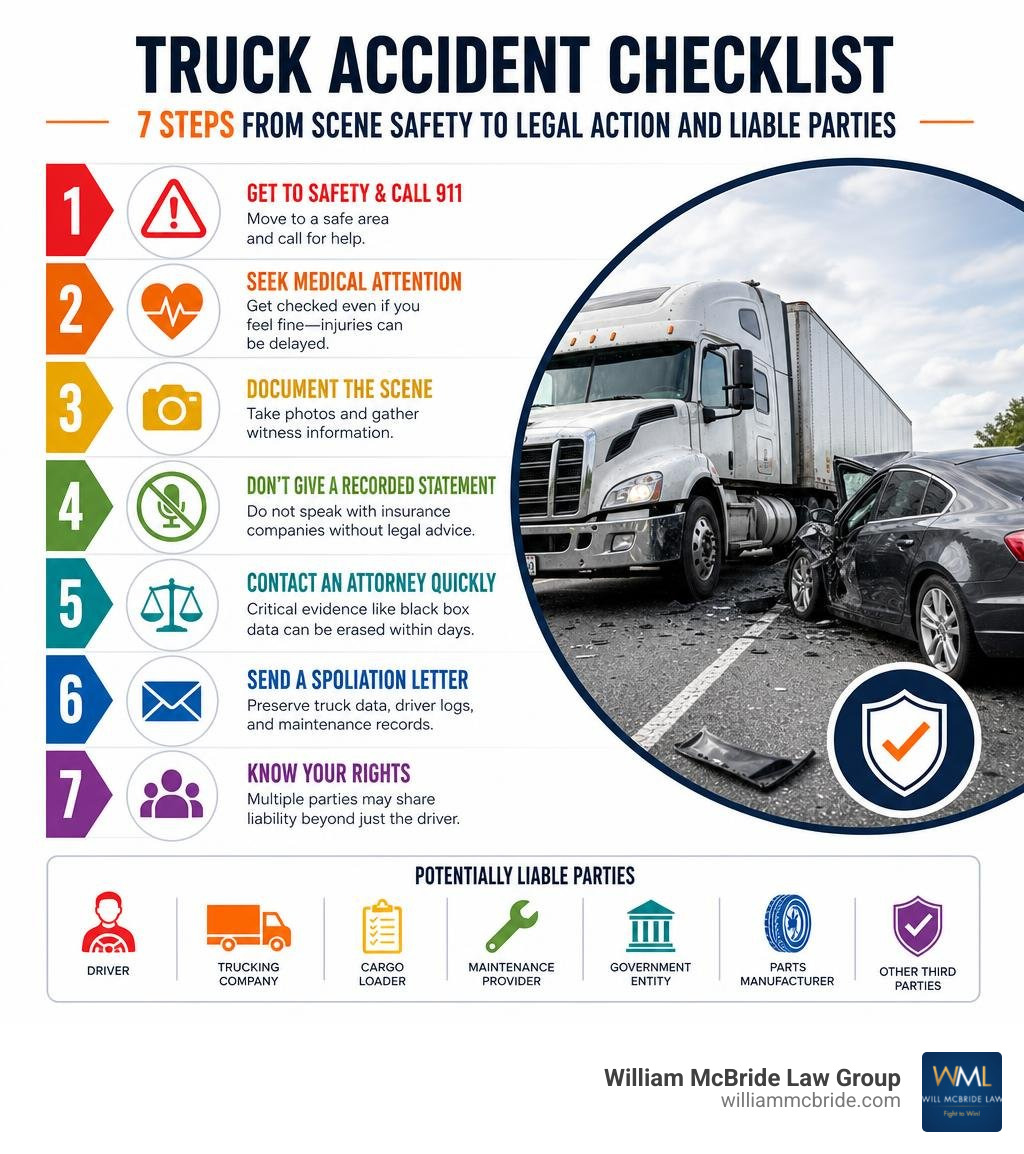
Quick Answer: What to Do After a Truck Accident
- Get to safety and call 911 immediately
- Seek medical attention even if you feel fine — injuries can be delayed
- Document the scene with photos and gather witness information
- Do not give a recorded statement to any insurance company without legal advice
- Contact an attorney quickly — critical evidence like black box data can be erased within days
- Send a spoliation letter to preserve truck data, driver logs, and maintenance records
- Know your rights — multiple parties may share liability beyond just the driver
The numbers behind these crashes are sobering. In 2024,
5,340 people died in large truck crashes across the United States — a figure that is 58% higher than it was in 2009. More than 161,000 more people were injured. Critically,
96% of people killed in two-vehicle crashes involving a passenger vehicle and a large truck were the passenger vehicle occupants. The sheer size and weight difference between a semi-truck and a family car makes these collisions categorically different from ordinary fender-benders.
That size difference also means the legal process is categorically different too. Truck accident cases involve federal regulations, multiple potentially liable parties, and insurance policies that can reach into the millions. Acting quickly — and carefully — matters enormously.
This checklist is designed to help you understand what to do, what to protect, and what rights you have after a serious truck crash.
Understanding the Unique Dangers of Truck Accidents

A fully loaded commercial
Tractor Trailer can weigh up to 80,000 pounds (40 tons), while the average passenger car weighs about 4,000 pounds (2 tons). This massive size discrepancy means that when a collision occurs, the laws of physics are stacked heavily against the smaller vehicle.
Furthermore, loaded commercial trucks require significantly more stopping distance than passenger cars. A semi-truck traveling at highway speeds needs 20% to 40% more distance to come to a complete stop than a standard passenger vehicle. This stopping distance discrepancy increases exponentially on wet or icy roads, or when the truck’s brakes are poorly maintained.
Federal data highlights the tragic consequences of these physical realities:
- In 2024, 5,218 large trucks were involved in fatal crashes, representing a 30% increase over the last decade.
- That same year, 120,724 large trucks were involved in crashes that caused injuries, representing an 18% increase since 2016.
- More than half of all fatal large-truck crashes occur on rural roads, where speeds are higher and emergency medical response times may be longer.
These accidents often happen in the blink of an eye. For example, the National Transportation Safety Board (NTSB) conducted a preliminary investigation into a tragic
NTSB crossover crash investigation where a commercial vehicle crossed the centerline of a highway, leading to a devastating head-on collision. When a massive truck loses control, passenger vehicle occupants have almost no time to react.
The Immediate Post-Crash Safety and Evidence Checklist

The moments immediately following
Auto Accidents involving commercial rigs are chaotic. However, the steps taken at the scene can protect both physical health and future legal rights.
- Prioritize Safety First: If the vehicle is operable and it is safe to do so, move it out of the active lanes of traffic to a safe spot. Turn on hazard lights immediately. If you are a truck driver or motorist with emergency gear, set up warning triangles behind the crash scene.
- Call 911 immediately: Request both police officers and emergency medical personnel. Even if there are no obvious severe injuries, a police report is vital. Law enforcement officers will document the scene, interview witnesses, and issue citations if regulations were violated.
- Exchange Essential Information: Collect names, contact details, driver’s license numbers, and insurance information from all drivers involved. For commercial trucks, write down the trucking company’s name, their USDOT number, and the license plate numbers of both the cab and the trailer.
- Document the Scene Thoroughly: Use a smartphone to take photos and videos of the entire scene from multiple angles. Capture vehicle damage, skid marks, road conditions, traffic signs, weather conditions, and any visible injuries.
- Identify and Speak with Witnesses: If anyone stopped to help or witnessed the crash, ask for their names and phone numbers. Their unbiased accounts can be crucial later.
- Seek a Comprehensive Medical Evaluation: Adrenaline can mask severe pain and serious internal injuries. Some injuries, such as internal bleeding or traumatic brain trauma, may not show symptoms immediately. Go to an emergency room or urgent care center as soon as possible.
Critical Steps to Take After Truck Accidents
While standard car accidents usually involve simple exchanges of insurance information,
truck accidents require immediate action to preserve highly specialized commercial data. Trucking corporations and their insurance carriers often deploy accident response teams to the crash site within hours. To protect your rights, several steps must be taken quickly:
- Send a Spoliation Letter: This is a formal legal notice sent to the trucking company demanding that they preserve all physical and electronic evidence related to the crash. Without this letter, trucking companies may legally overwrite or destroy critical data after a set period.
- Secure Black Box Data: Commercial trucks are equipped with Electronic Control Modules (ECMs), commonly known as “black boxes.” This device records critical data points leading up to a crash, including vehicle speed, braking activity, throttle position, and system faults.
- Obtain Electronic Logging Device (ELD) Records: Federal law requires truck drivers to use ELDs to track their hours of service. This data helps show whether the driver was fatigued or operating in violation of federal safety limits.
- Preserve Physical Evidence: This includes the damaged vehicles, tire fragments from blowouts, and cargo securement straps.
Navigating Liability and the “Deep Pocket Chain”
Determining fault in a commercial truck crash is far more complex than in a standard passenger car accident. Instead of looking only at the driver, investigators must look at the entire commercial chain of operation. This is often referred to as the “deep pocket chain” because multiple corporate entities may share financial responsibility for the collision.
In a
Multiple Car Pile Up or a single-truck collision, any of the following parties may share liability:
- The Truck Driver: For negligent behaviors such as speeding, distracted driving, driving under the influence of drugs or alcohol, or falling asleep at the wheel.
- The Trucking Company (Motor Carrier): For forcing drivers to exceed safety hours, failing to perform background checks, or failing to properly train employees.
- The Cargo Loaders, Shippers, or Freight Brokers: If cargo is overloaded, unevenly balanced, or improperly secured, it can shift during transit and cause a rollover, jackknife, or debris spill. In Denver and along Colorado’s I-70 freight corridors, unsecured loads are a recurring safety concern because steep grades, sudden braking, and heavy traffic can turn a poorly secured load into a serious hazard. Investigators may examine bills of lading, loading dock records, tie-down practices, weight distribution, and whether the shipper or third-party loader followed federal cargo securement rules.
- Maintenance Contractors: If a third-party maintenance company fails to properly inspect or repair vital truck systems, such as the brakes or steering, they can be held liable for mechanical failures.
How Federal Regulations Impact Liability in Truck Accidents
Commercial trucking is heavily regulated by the Federal Motor Carrier Safety Administration (FMCSA). These regulations are designed to keep the public safe, and any violation of them can serve as powerful evidence of negligence in a lawsuit.
- Hours-of-Service (HOS) Rules (49 CFR Part 395): These rules dictate how long a commercial driver can operate before taking a mandatory rest break. For example, drivers are generally limited to 11 hours of driving within a 14-hour on-duty window. Violations of these rules directly contribute to driver fatigue.
- Vehicle Maintenance Standards (49 CFR Part 396): Motor carriers are required to systematically inspect, repair, and maintain all commercial vehicles under their control. Brake failures, worn tires, and broken lights are common maintenance violations.
- Out-of-Service Rates: If a trucking company has a history of high out-of-service violation rates during roadside inspections, it demonstrates a corporate pattern of neglecting safety regulations.
- Driver Qualification Files: Trucking companies must maintain detailed records for each driver, including background checks, road test results, medical examiner certificates, and drug testing records.
Understanding Your Damages and Legal Rights
Because
truck accidents cause such severe damage, the financial, physical, and emotional toll on victims can be immense. If you have been injured, you may be entitled to recover compensation for several types of damages:
- Economic Damages: These are quantifiable financial losses, including emergency medical bills, ongoing rehabilitation costs, future medical care, and Lost Wages if you are unable to work.
- Non-Economic Damages: These compensate for non-financial losses, such as physical pain and suffering, emotional distress, loss of enjoyment of life, and Permanent Disability.
- Wrongful Death Damages: If a family member was killed in a commercial truck crash, surviving loved ones can seek compensation for funeral expenses, loss of financial support, and loss of companionship through a Wrongful Death claim.
Severe impacts from these collisions often lead to catastrophic injuries, such as
Brain Injuries,
Spinal Injuries, or
Paralysis. Because of the severe nature of these injuries, commercial truck insurance policy limits are much higher than standard passenger car policies, frequently ranging from $750,000 to over $5 million.
Passenger Car Claims vs. Commercial Truck Claims
| Feature |
Passenger Car Claims |
Commercial Truck Claims |
| Typical Defendant |
Individual driver |
Multiple corporations (carrier, loader, manufacturer) |
| Primary Regulations |
State traffic laws |
State traffic laws & complex Federal FMCSA regulations |
| Minimum Insurance Limits |
Usually $15,000 to $50,000 |
Federal minimum of $750,000 to $5,000,000+ |
| Key Evidence |
Police report, basic photos |
Black box data, ELD logs, maintenance records, dispatch files |
| Injury Severity |
Often minor to moderate |
Frequently catastrophic, life-altering, or fatal |
Frequently Asked Questions about Truck Accidents
Dealing with the aftermath of a commercial truck crash is overwhelming. Here are answers to some of the most common questions victims and their families ask.
What is a spoliation letter and why is it critical?
A spoliation letter is a formal legal demand sent to the trucking company and their insurance carrier immediately after a crash. It instructs them to preserve all physical and digital evidence related to the collision.
This letter is critical because trucking companies often have policies that allow them to overwrite electronic logging data or destroy internal records after a certain number of weeks. Once they receive a spoliation letter, any destruction of evidence can be treated as “spoliation” in court, which can lead to severe legal penalties for the trucking company.
Who can be held liable in a commercial truck crash?
Unlike typical car accidents where only the drivers are involved, commercial truck crashes can involve multiple liable parties. Depending on the details of the investigation, liability may rest with the truck driver, the motor carrier, the cargo loading company, the maintenance contractor, or even the manufacturer of a defective truck part.
How long do I have to file a lawsuit after a truck crash?
The time limit to file a lawsuit is known as the statute of limitations, and it varies by state.
- In Colorado, the statute of limitations for bodily injury resulting from a motor vehicle accident is generally three years from the date of the crash.
- In Washington and New Mexico, the limit is generally three years.
- In Florida, the limit is generally two years.
If you are filing a claim against a government entity (for example, if you were hit by a municipal waste truck), you may have as little as
six months to file a formal notice of claim. Missing these deadlines can permanently bar you from seeking compensation.
Conclusion
If you or a loved one has been injured in a commercial truck collision, you do not have to navigate the complex legal system alone. Trucking companies have lawyers working to protect their interests from day one — you deserve an attorney and the team at Will McBride Law Group helping you protect your rights and preserve critical evidence early.
Will McBride Law approaches every case with deep compassion for the physical and financial struggles working families face after a crash. Known publicly as Abogado William, the firm is committed to providing bilingual, accessible legal support. Will McBride Law serves clients in both English and Spanish (
Se habla español), ensuring that language is never a barrier to seeking justice.
Whether you are seeking a
Truck Accident Lawyer in Denver, or need assistance in Seattle, Albuquerque, or Orlando, Will McBride Law is prepared to investigate the crash, preserve vital evidence, and stand ready for trial if the insurance companies refuse to offer a fair settlement.
Take the first step toward peace of mind today. Anyone injured in a serious accident should not have to guess about their legal options. Contact Will McBride Law for a free, confidential case review to discuss your rights and help you make informed decisions for your family’s future.
Disclaimer: The information provided in this article is for general educational purposes only and does not constitute formal legal advice. Case outcomes depend entirely on the unique facts and evidence of each individual situation.
Illustrations are for dramatization purposes only.