When the Road Isn’t Safe: What You Need to Know About Bicycle & Pedestrian Accidents
Bicycle and pedestrian accidents are a serious and growing public safety crisis in the United States — and the numbers behind them are sobering.
Quick facts for people searching about this topic:
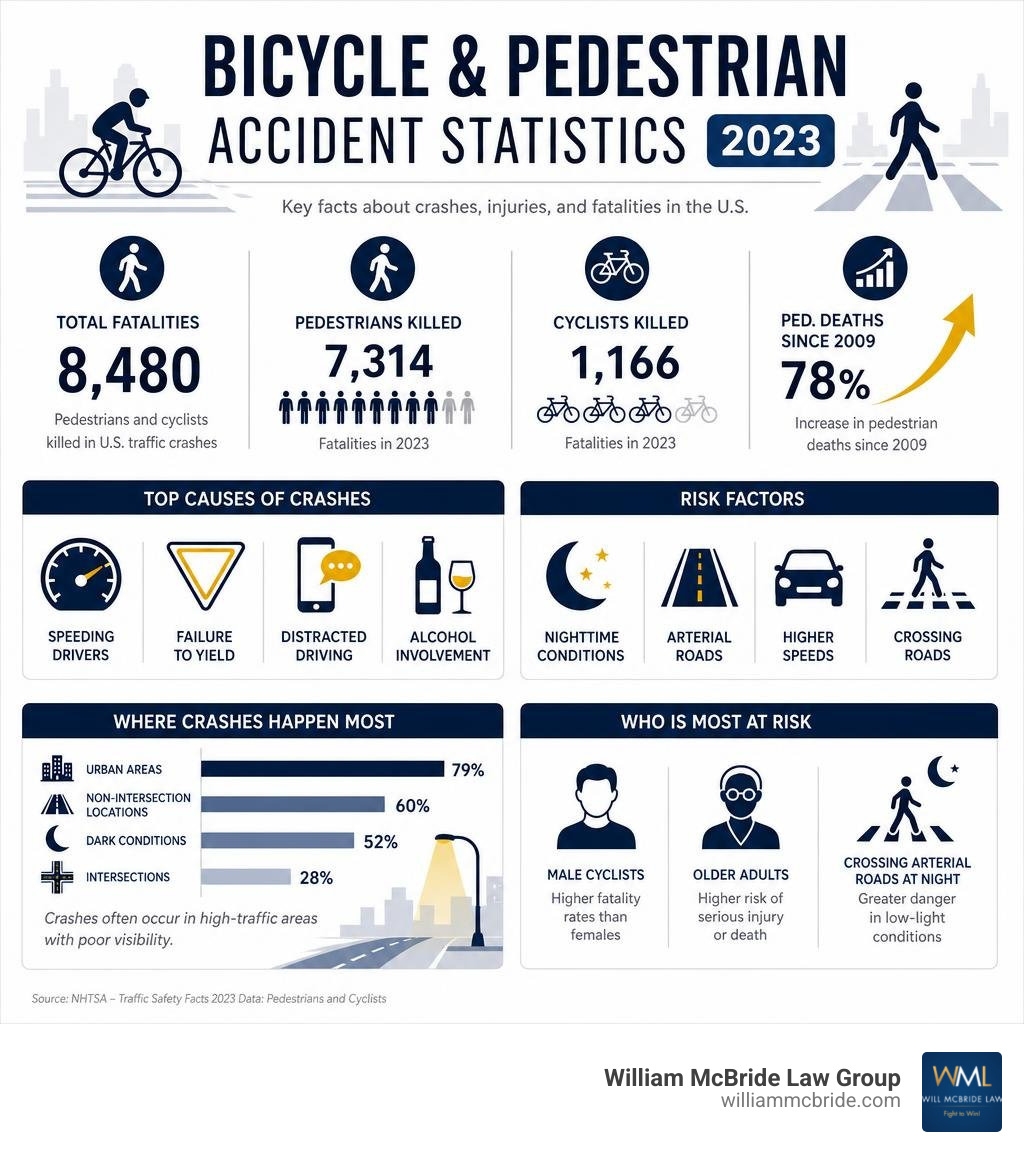
- What happened: Over 8,400 cyclists and pedestrians were killed in U.S. traffic crashes in 2023
- Who is most at risk: Male cyclists, older adults, people crossing arterial roads at night
- Top causes: Speeding drivers, failure to yield, distracted driving, alcohol involvement
- Where crashes happen most: Urban arterial roads, dark conditions, non-intersection locations
- What you can do: Seek medical care immediately, report the crash, document the scene, and speak with an attorney about your legal options
Every day in America, people are struck by vehicles while walking or riding a bike. Unlike drivers, they have no seat belt, no airbag, and no steel frame protecting them. The result is often catastrophic — broken bones, brain injuries, spinal damage, or death.
In 2023 alone,
7,314 pedestrians and
1,166 bicyclists were killed on U.S. roads. Tens of thousands more were seriously injured. Pedestrian deaths have risen
78% since 2009. These are not just statistics — they are real people, real families, and real losses.
If you or someone you love has been hurt in one of these crashes, you are not alone — and you have rights worth understanding.
Understanding the Rising Toll of Bicycle & Pedestrian Accidents
To understand the scope of the problem, it helps to look closely at the numbers. Federal and state transportation agencies track these incidents to identify trends and find solutions. According to
National traffic safety data on bicyclists, the number of people killed while riding bicycles has been climbing steadily over the last decade.
In 2023, the 1,166 pedalcyclist fatalities represented a 4% increase from the 1,117 deaths recorded in 2022. This group accounted for 2.9% of all traffic fatalities nationwide.
Injuries are also on the rise. An estimated 49,989 pedalcyclists were injured in traffic crashes in 2023, which is an 8% increase from the 46,195 injuries reported in 2022. This means cyclists make up roughly 2% of all people injured on our roads.
When a vehicle strikes a person, the physical damage is rarely minor. Pedestrians and cyclists often suffer severe, life-altering trauma. Those who survive these collisions frequently face a long road to recovery from severe
Pedestrian Injuries or debilitating
Bicycle Injuries.
| Metric (2023 Data) |
Pedestrians |
Bicyclists (Pedalcyclists) |
| Fatalities |
7,314 |
1,166 |
| Estimated Injuries |
~68,000 |
49,989 |
| Share of Traffic Deaths |
~18% |
2.9% |
| Year-over-Year Change (Deaths) |
Rising |
4% Increase |
These figures highlight a harsh reality: our streets have become increasingly hostile to those who are not inside a motor vehicle.
Key Risk Factors and Causes of Vulnerable Road User Crashes
Why are
bicycle & pedestrian accidents becoming more frequent and severe? Several factors combine to create dangerous conditions for vulnerable road users. Speed, road design, and motorist behavior are the primary drivers of this safety crisis.
One of the most critical factors is speed. When a vehicle is moving fast, the driver has less time to react, and the physical force of an impact increases exponentially. The average risk of serious injury or death for a pedestrian rises dramatically with even small increases in speed:
- 20 mph: 18% risk of serious injury or death
- 25 mph: 32% risk
- 35 mph: 67% risk
- 45 mph: 90% risk
- 55 mph: 97% risk
Alcohol also remains a persistent hazard. In 2023, alcohol involvement (defined as a blood alcohol concentration of .01 g/dL or higher) was reported in 34% of all fatal pedalcyclist crashes. This includes cases where either the driver or the cyclist had consumed alcohol. In fact, 22% of the pedalcyclists who lost their lives had a blood alcohol concentration at or above .01 g/dL. When drivers choose to get behind the wheel while impaired, they pose a deadly threat to everyone around them. Seeking accountability after a crash often involves looking closely at the actions of
Drunk Drivers who ignore the safety of others.
Motorists who fail to share the road safely are a primary cause of these crashes, turning ordinary commutes into devastating
Auto Accidents.
Primary Causes of Bicycle & Pedestrian Accidents
Distracted driving has reached epidemic levels. Whether a driver is texting, adjusting a navigation system, or talking on the phone, taking their eyes off the road for even a few seconds can be fatal for a nearby walker or cyclist. Drivers also frequently fail to yield the right-of-way at crosswalks, make turns without looking for pedestrians, or pass cyclists too closely.
The design of our roadways also plays a major role. Between 2018 and 2022, more than 80% of pedestrian deaths occurred on roads with speed limits of 35 mph or greater. High-speed roads are rarely designed with walking or cycling in mind.
Arterial roadways—the busy, multi-lane streets designed to move large volumes of traffic quickly—are particularly dangerous. In 2023, 65% of bicyclist deaths occurred on principal or minor arterial roads. What makes this statistic so striking is that arterials make up only 10% of the national roadway system, yet they account for nearly two-thirds of cyclist fatalities.
This trend is highly visible in growing metropolitan areas. For example,
Colorado pedestrian fatality trends show a troubling rise in deaths on busy corridors. When local infrastructure fails to protect walkers and riders, finding legal guidance becomes essential..
Demographic and Geographic Disparities in Bicycle & Pedestrian Accidents
The risks of walking and cycling are not distributed evenly. Federal data reveals significant disparities based on sex, race, age, and geography.
Males are over-represented in traffic statistics. In 2023, the pedalcyclist fatality rate per 100,000 people was more than seven times higher for males than for females, and the injury rate was five times higher. Additionally, older adults face a heightened risk; the average age of pedalcyclists killed in 2023 was 48, and 90% of those who died were age 20 or older.
Racial disparities are also pronounced. Federal benchmarking reports show that Black individuals are disproportionately affected, accounting for over 19% of pedestrian deaths despite making up approximately 14% of the U.S. population.
Geographic factors and lighting conditions also dictate where and when these accidents happen:
- Urban vs. Rural: Bicyclist deaths have shifted dramatically over the decades. In 1975, deaths were split roughly evenly between urban and rural areas. By 2023, 81% of bicyclist deaths occurred in urban areas, where traffic density is high and cycling infrastructure is often incomplete.
- Lighting: Darkness is a major risk factor. In 2023, 53% of pedalcyclist fatalities occurred in the dark, compared to 42% in daylight, 3% at dusk, and 2% at dawn.
- Location: In 2023, 62% of pedalcyclist fatalities occurred at non-intersection locations, while 28% occurred at intersections.
When these risk factors culminate in a fatal crash, surviving family members are left to deal with sudden, overwhelming grief. In these difficult times, filing a legal claim for
Wrongful Death can help families seek justice and hold the negligent parties accountable.
How Vehicle Design and Technology Impact Safety

As consumer preferences have shifted toward larger passenger vehicles, the physical design of the cars on our roads has changed. Today, light trucks, SUVs, and large crossovers dominate the market. While these vehicles offer excellent protection for their occupants, they pose a significantly higher risk to pedestrians and cyclists.
The shape and height of a vehicle’s front end heavily influence the severity of an impact. Vehicles with hoods positioned more than 40 inches off the ground are approximately 45% more likely to cause pedestrian fatalities than vehicles with lower, more sloping hoods.
Taller vehicles with blunt, vertical front ends are twice as likely to knock a pedestrian down and run them over, rather than throwing them onto the hood of the car. This leads to severe crushing injuries to the torso and head. Additionally, the wide front pillars and high ride height of modern SUVs create large blind zones. A driver-side blind zone can raise the risk of striking a pedestrian during a left-hand turn by as much as 70%.
To combat these design hazards, manufacturers have introduced crash avoidance technologies. Pedestrian detection systems and automatic emergency braking (AEB) are designed to scan the road ahead and apply the brakes if a collision is imminent.
In real-world conditions, these systems have shown promise, reducing pedestrian crash rates by 27% and injury crash rates by 30%. However, they are not perfect. Many systems perform poorly in dark conditions—the very time when more than half of all fatal pedestrian and cyclist crashes occur.
Electric and hybrid vehicles present another unique safety challenge. Because electric motors are nearly silent at low speeds, pedestrians and cyclists often cannot hear them approaching. Research shows that hybrid vehicles are 39% more likely to collide with pedestrians in areas with speed limits of 35 mph or slower. To address this, federal regulations require electric and hybrid vehicles to emit an audible motor-like sound when traveling at speeds under 19 mph.
Proven Strategies and Laws to Protect Cyclists and Pedestrians
Reducing the frequency and severity of
bicycle & pedestrian accidents requires a coordinated, multi-faceted approach. Traffic safety professionals often refer to the “4 E’s” framework to guide these efforts:
- Engineering: Designing safer roads, vehicles, and intersections.
- Enforcement: Ensuring road users follow speed limits and traffic laws.
- Education: Teaching drivers, walkers, and riders how to share space safely.
- Emergency Response: Providing rapid, high-quality medical care after a crash.
Engineering solutions are among the most effective ways to prevent collisions. Physical infrastructure changes can dramatically alter how drivers behave and provide dedicated space for vulnerable road users. Proven engineering measures include:
- Protected Bike Lanes: Separating cyclists from motor vehicles with physical barriers, such as curbs or bollards, reduces conflict points.
- Pedestrian Hybrid Beacons (PHBs): These overhead warning lights, used at mid-block crossings, are associated with a 45% reduction in crashes where pedestrians are killed or injured.
- Rapid-Flashing Beacons: Yellow flashing lights at crosswalks alert drivers to the presence of walkers, reducing pedestrian crashes by 47%.
- Leading Pedestrian Intervals (LPIs): Adjusting traffic signals to give pedestrians a head start of 3 to 7 seconds before vehicles get a green light helps walkers cross safely and makes them more visible to turning drivers.
While road design prevents crashes, personal safety equipment mitigates injuries when a collision does occur. Bicycle helmets are highly effective at preventing severe trauma. Research shows that wearing a helmet reduces the odds of a head injury by 50% and reduces the risk of head, face, or neck injuries by 33%.
Despite these clear benefits, usage rates remain low. In 2023, only about 14% of bicyclists who were fatally injured were confirmed to be wearing helmets. State and local laws regarding helmets vary widely, with some municipalities requiring them for all riders and others mandating them only for children under a certain age.
When safety measures fail, the physical consequences are often devastating. Victims frequently suffer traumatic
Brain Injuries or permanent
Spinal Injuries, both of which require extensive, long-term medical care and legal advocacy.
Frequently Asked Questions About Bicycle and Pedestrian Safety
If you are involved in a collision, taking the right steps in the immediate aftermath is vital for your physical health and any future legal claim:
- Seek Medical Care: Call 911 immediately. Even if you do not feel severe pain right away, adrenaline can mask serious internal injuries or head trauma.
- Contact the Police: Ensure an officer responds to the scene to file an official accident report. This report is a crucial piece of objective evidence.
- Gather Evidence: If you are physically able, take photos of the vehicle, your bicycle, the road conditions, any visible injuries, and the surrounding layout of the street.
- Identify Witnesses: Ask witnesses for their names and phone numbers. Their independent accounts can be invaluable.
- Keep Your Equipment: Do not repair your bicycle, wash your clothes, or discard your damaged helmet. These items preserve physical evidence of the impact.
Once you are safe and your medical needs are addressed, reaching out to a legal professional can help protect your rights. You can
Contact Us to discuss the facts of your case and learn about your options.
How do helmet laws and usage rates affect bicyclist injury outcomes?
Helmet laws and personal usage rates directly impact the severity of injuries seen in emergency rooms. Because helmets reduce the risk of head injuries by 50%, communities with higher helmet compliance rates generally see fewer traumatic
Brain Injuries and lower fatality rates among cyclists. While helmet laws vary by state and city, wearing a helmet is always a smart, preventative practice, regardless of whether local ordinances require it.
What are the legal options if a loved one is killed in a hit-and-run?
Hit-and-run accidents are particularly devastating because they leave families searching for answers while grieving a sudden loss. When a driver flees the scene, law enforcement will launch an investigation to identify the motorist.
With patience and diligent police work, these investigations can lead to justice. For example, in a
Colorado bicycle hit-and-run case, Boulder police arrested a Parker man within hours after a cyclist was seriously injured in a crash involving a pickup truck.
If the driver is identified, the surviving family members can file a civil
Wrongful Death lawsuit to seek compensation for medical bills, funeral expenses, lost financial support, and the loss of companionship. In cases where the driver is never found, families may still be able to seek compensation through their own uninsured motorist insurance policies.
Conclusion
Sharing the road is a collective responsibility. Whether you are driving a car, walking to work, or riding a bicycle, staying alert and following traffic laws can save lives. Yet, even the most cautious pedestrians and cyclists cannot always avoid the negligence of a distracted or speeding driver.
When a serious crash occurs, the physical, emotional, and financial toll can be overwhelming. Attorney Will McBride and the team at Wlll McBride Law are dedicated to standing beside injured individuals and their families. Known publicly as Abogado William, he is a trial-ready advocate whose mission centers on helping ordinary people navigate the complex aftermath of a serious accident.
With a strong commitment to community service, Wlll McBride Law provides compassionate, bilingual representation. We serve clients in both English and Spanish (
Se habla español), ensuring that language is never a barrier to seeking justice. Our firm focuses on a wide range of
Practice Areas to help you find the right path forward, especially when pursuing claims for
Auto Related Injuries.
If you or a loved one has been injured, you do not have to face the insurance companies alone. Attorney Will McBride offers free, confidential case reviews to help you understand your legal options and make informed decisions about your recovery.
Disclaimer: The information provided in this article is for general educational purposes only and does not constitute formal legal advice. Case outcomes depend entirely on the unique facts and evidence of each individual situation. Illustrations are for dramatization purposes only.