Motorcycle Accidents: What Every Rider and Family Member Should Know
Motorcycle accidents are among the most devastating events on American roads — and if you or someone you love has been hurt, you’re probably looking for answers fast.
Here’s a quick overview of what matters most:
| Topic | Key Facts |
|---|---|
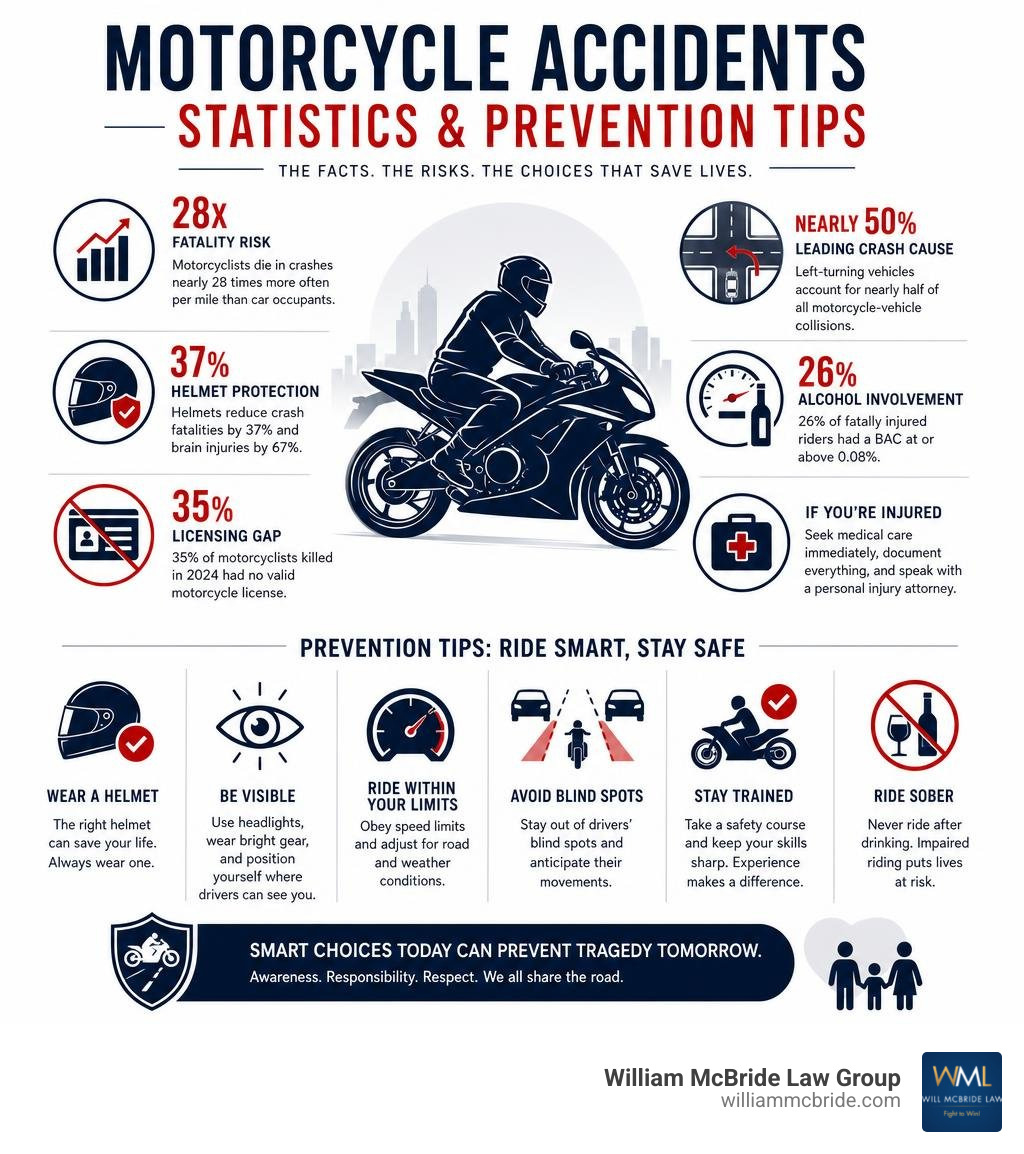
| Fatality risk | Motorcyclists die in crashes nearly 28 times more often per mile than car occupants |
| Leading crash cause | Left-turning vehicles account for nearly half of all motorcycle-vehicle collisions |
| Helmet protection | Helmets reduce crash fatalities by 37% and brain injuries by 67% |
| Alcohol involvement | 26% of fatally injured riders had a BAC at or above 0.08% |
| Licensing gap | 35% of motorcyclists killed in 2024 had no valid motorcycle license |
| If you’re injured | Seek medical care immediately, document everything, and speak with a personal injury attorney |
Motorcycles make up just 3% of registered vehicles in the United States. Yet in 2024, motorcyclists accounted for 16.2% of all traffic fatalities — 6,228 lives lost in a single year.
These aren’t just numbers. Behind each one is a family dealing with grief, medical bills, lost income, and unanswered questions about what happened and who is responsible.
The roads carry real risk for riders. Motorcycles offer almost no physical protection in a crash. Other drivers often fail to see them. And when something goes wrong at highway speeds, the consequences are severe.
Understanding why these crashes happen — and what your rights are afterward — can make a real difference.
Will McBride Law believes that injured riders and their families deserve clear, honest information. Not legal jargon. Not pressure. Just straight answers about what happened, what comes next, and what the law allows.
This guide covers the most important facts about motorcycle accidents: the statistics, the causes, the safety factors, and the legal options available to those who have been hurt.
Understanding the Reality of Motorcycle Accidents: Key Statistics and Trends
To truly address the problem of motorcycle accidents, one must first look at the hard data. The numbers paint a sobering picture of vulnerability on our highways. Nationally, the 6,228 motorcyclist deaths in 2024 represented a 23% increase in motorcycle fatalities since 2019. This means that motorcycle riders continue to be disproportionately represented in fatal traffic crashes.

When we examine how these statistics play out in the specific communities served by Will McBride Law, the local trends mirror these national challenges:
- Colorado: The state has seen a significant upward trend in rider casualties. According to state traffic data, Colorado motorcycle deaths have risen 57% in 10 years. This surge has prompted state safety officials to increase awareness campaigns.
- Washington: In the Pacific Northwest, keeping track of rider safety remains a priority. The Motorcyclists Data – Washington Traffic Safety Commission highlights the persistent risk factors that local riders face, particularly during the rainy season and on winding rural highways.
- New Mexico: In Albuquerque and surrounding areas, high-speed collisions frequently make local headlines. Media coverage of a recent Motorcycle Crash – ABQ RAW serves as a reminder of how quickly a ride can turn tragic on busy southwestern roads.
- Florida: Florida’s year-round riding weather unfortunately leads to high numbers of crashes. Local news reports, such as when an Orlando road shut down due to fatal motorcycle crash investigation, emphasize how traffic is impacted and families are altered in an instant.
Statistical reports from 2024 also reveal key environmental factors in these crashes:
- Urban vs. Rural: 65% of motorcyclist fatalities occurred on urban roads, where congested intersections and frequent lane changes increase the likelihood of multi-vehicle collisions.
- Seasonal Peaks: 57% of motorcycle deaths occurred between May and September. The peak usually occurs in August, while the lowest numbers are recorded in January.
- Weekend Risks: 46% of fatal crashes occurred on weekends, when recreational riding is at its highest and alcohol use is more common.
Regardless of where a crash occurs, the resulting Motorcycle Injuries can be life-altering, requiring extensive medical care, rehabilitation, and long-term financial support.
The Leading Causes of Motorcycle Accidents and How to Prevent Them
Many passenger vehicle drivers assume that motorcyclists are always the ones riding recklessly. In reality, most multi-vehicle crashes are caused by the negligence of other motorists. Because motorcycles have a smaller profile, other drivers often fail to spot them in traffic or misjudge their speed.
To prevent motorcycle accidents, both riders and motorists must understand the primary hazards on the road:
- Driver Distraction: Drivers texting, adjusting navigation systems, or talking on the phone frequently fail to notice motorcycles sharing the road.
- Lane Switching: Passenger vehicles often merge into a motorcyclist’s lane without checking their blind spots.
- Roadway Maintenance: Potholes, gravel, uneven pavement, and wet leaves that might cause a minor bump for a car can cause a motorcyclist to lose control completely.
- Door-Opening Incidents: In busy urban areas like Denver or Seattle, parked drivers opening their doors without looking can cause a rider to collide with the door at high speeds.
To stay safe, riders are encouraged to practice defensive riding techniques:
- Position the motorcycle where drivers can see you in their mirrors.
- Keep the motorcycle in gear at intersections with a hand on the throttle in case you need to move quickly.
- Continually scan the road ahead for changing conditions and hazards.
How Left-Turning Vehicles and Intersections Cause Motorcycle Accidents
Collisions involving left-turning vehicles represent the single most common cause of multi-vehicle motorcycle accidents, accounting for nearly half of all motorcycle-car crashes.
These collisions typically happen when a passenger vehicle turns left at an intersection directly in front of an oncoming motorcycle. The driver of the car either fails to see the motorcycle entirely or misjudges how fast it is traveling, assuming they have enough time to clear the turn.
The danger is just as real for riders in the Denver area. In one local example, Denver police searched for a lime green Dodge Ram after a near-fatal hit-and-run crash involving a motorcycle at South Broadway Street and East Iowa Avenue. Police said the truck was turning left before striking the northbound motorcycle, showing how quickly a left-turn conflict can become catastrophic.
To prevent left-turn collisions, riders should:
- Watch the front tires of vehicles waiting to turn left; tire movement is often the first sign that a driver is starting to turn.
- Reduce speed when approaching intersections, even if they have the right of way.
- Flash their brake lights by tapping the lever lightly to alert drivers behind them when slowing down.
Single-Vehicle Crashes, Speeding, and Road Hazards
While multi-vehicle crashes are highly common, approximately 35% of motorcyclist deaths in 2024 occurred in single-vehicle crashes. In these situations, a rider might lose control due to excessive speed, a sudden road hazard, or an unexpected obstacle.
Speeding reduces a rider’s ability to navigate curves safely and increases the stopping distance required to avoid an obstacle. Colorado riders face these risks on mountain roads as well as city streets. For example, a motorcycle crash on Mestaa’ehehe Pass near the Mount Blue Sky Scenic Byway shut down a winding two-lane highway with curves and steep grades while Colorado State Patrol investigated the incident.
When faced with a sudden obstacle, riding educators advise against “laying down the bike” on purpose. Modern tires and brakes are highly effective, and riders have a much better chance of avoiding injury by staying on the bike and utilizing maximum, controlled braking on both the front and rear wheels.
Critical Safety Factors: Helmets, Licensing, and Alcohol Impairment
Rider safety depends heavily on protective gear, formal training, and responsible decision-making. When these safety measures are ignored, the likelihood of a fatal outcome increases dramatically.
The Lifesaving Impact of Helmets and State Laws
There is no piece of safety equipment more effective at preventing death than a DOT-compliant motorcycle helmet. Federal data shows that helmets are:
- 37% effective in preventing crash fatalities.
- 67% effective in preventing traumatic brain injuries.
Unhelmeted riders are three times more likely to suffer traumatic Brain Injuries compared to those wearing proper protection. Because the brain is incredibly vulnerable to impact, even a low-speed fall can result in permanent cognitive damage, memory loss, or Paralysis.
Helmet use varies significantly depending on local state laws. In 2024, 89% of fatally injured riders were wearing helmets in states with universal helmet laws, compared to only 40% in states without such mandates.
Because head trauma can alter a family’s future in an instant, understanding your legal rights is critical if a loved one has suffered a head injury. For detailed guidance on navigating these complex cases, families can read about Why You May Need a Traumatic Brain Lawyer for Your Injury in Denver, Colorado. If the crash was caused by another driver’s negligence, the injured rider may be entitled to compensation to cover lifelong care.
Licensing Status and Alcohol Impairment in Motorcycle Accidents
Two other major risk factors in motorcycle crashes are riding without a valid license and riding under the influence of alcohol.
- Licensing: In 2024, 35% of motorcycle operators involved in fatal crashes were riding without a valid motorcycle license. Proper licensing ensures that a rider has demonstrated basic vehicle control and hazard-avoidance skills through a state-approved safety course.
- Alcohol Impairment: Alcohol plays a massive role in fatal crashes. In 2024, 26% of fatally injured motorcycle drivers had a blood alcohol concentration (BAC) at or above the legal limit of 0.08%. In single-vehicle crashes, this number jumped to 39%.
Impairment severely affects the balance, coordination, and split-second judgment required to operate a motorcycle safely. Motorcyclists who choose to ride while intoxicated put themselves and everyone else on the road at risk. When innocent riders are struck by Drunk Drivers, the legal system provides a path to hold those negligent drivers fully accountable for the harm they cause.
Frequently Asked Questions About Motorcycle Accidents
What are the most common injuries sustained in a motorcycle crash?
Because motorcyclists are completely exposed to the elements and the force of impact, they often sustain severe, multi-system trauma in a crash. Some of the most common injuries include:
- Traumatic Brain Injuries (TBIs): Ranging from concussions to severe cognitive impairment, these occur when the head strikes the ground or another vehicle.
- Spinal Cord Injuries: Impact can fracture vertebrae, leading to permanent Spinal Injuries or complete Paralysis.
- Road Rash: Severe skin abrasions caused by sliding across pavement can lead to permanent scarring, nerve damage, and serious infections.
- Fractures: Broken bones in the legs, arms, pelvis, and ribs are incredibly common as riders naturally try to brace themselves during a fall.
How do helmet laws vary by state and affect rider safety?
Helmet laws in the United States are divided into two main categories:
- Universal Helmet Laws: These laws require all motorcycle riders and passengers to wear a helmet, regardless of age. States with these laws see significantly higher helmet compliance and lower fatality rates.
- Partial Helmet Laws: These laws only require helmets for riders under a certain age (usually 18 or 21) or those who do not carry a minimum amount of medical insurance.
In states without universal laws, helmet use drops significantly, leading to a higher rate of severe head injuries and fatalities per capita.
What legal options do injured riders have to recover lost wages?
If you are injured in a motorcycle accident caused by another driver’s negligence, you have the right to file a personal injury claim to seek compensation for your financial losses.
A successful legal claim can help you recover compensation for:
- Immediate and future medical bills.
- Rehabilitation and physical therapy expenses.
- Lost Wages if you are temporarily or permanently unable to return to work.
- Pain, suffering, and emotional distress.
To protect your legal rights, it is crucial to avoid discussing the details of the crash with the other driver’s insurance company before speaking with a qualified attorney. Insurance adjusters often try to shift the blame onto the motorcyclist to reduce the amount they have to pay.
Conclusion: Protecting Your Rights After a Crash
A serious motorcycle crash can turn your life upside down in an instant. Amid medical appointments, physical pain, and growing financial stress, dealing with insurance companies can feel completely overwhelming.
Will McBride Law is dedicated to helping injured riders and their families navigate this difficult journey. Known publicly as Abogado William, Will McBride is a trial-ready advocate who believes that every client deserves respect, clear communication, and meticulous case preparation.
The firm’s approach is built on a simple principle: while a fair settlement is often the best path forward, true fairness only comes when you are fully prepared to stand up and fight in court if the insurance company refuses to do the right thing. This aggressive trial preparation has helped the firm recover substantial compensation for thousands of clients.
Will McBride Law proudly serves working families and diverse communities in Colorado, Washington, New Mexico, and Florida. To ensure that everyone has access to justice, the firm provides fully bilingual legal services (Se habla español).
If you or a loved one has been injured, you do not have to guess about your next steps or face the insurance companies alone. Contact a Motorcycle Accident Lawyer in Denver or at any of our office locations today for a confidential case review to understand your options and protect your family’s future.
If a motorcycle crash may involve a Colorado public entity or public employee, the notice deadline is especially important. Under the Colorado Governmental Immunity Act, C.R.S. § 24-10-109(1), a claimant generally must provide written notice within 182 days after discovering the injury. This deadline is strict, so injured riders should speak with an attorney as soon as possible if a government vehicle, public employee, dangerous public road condition, or other public-entity issue may be involved.
Disclaimer: This article is provided for general informational purposes only and should not be considered legal advice. Every case is unique, and outcomes depend on the specific facts and circumstances involved. Any examples, images, or illustrations are for dramatization purposes only.