When a Truck Crash Turns Your Life Upside Down, Here’s What to Do First
If you’re looking for a
truck accident attorney in Denver, here is what you need to know right away:
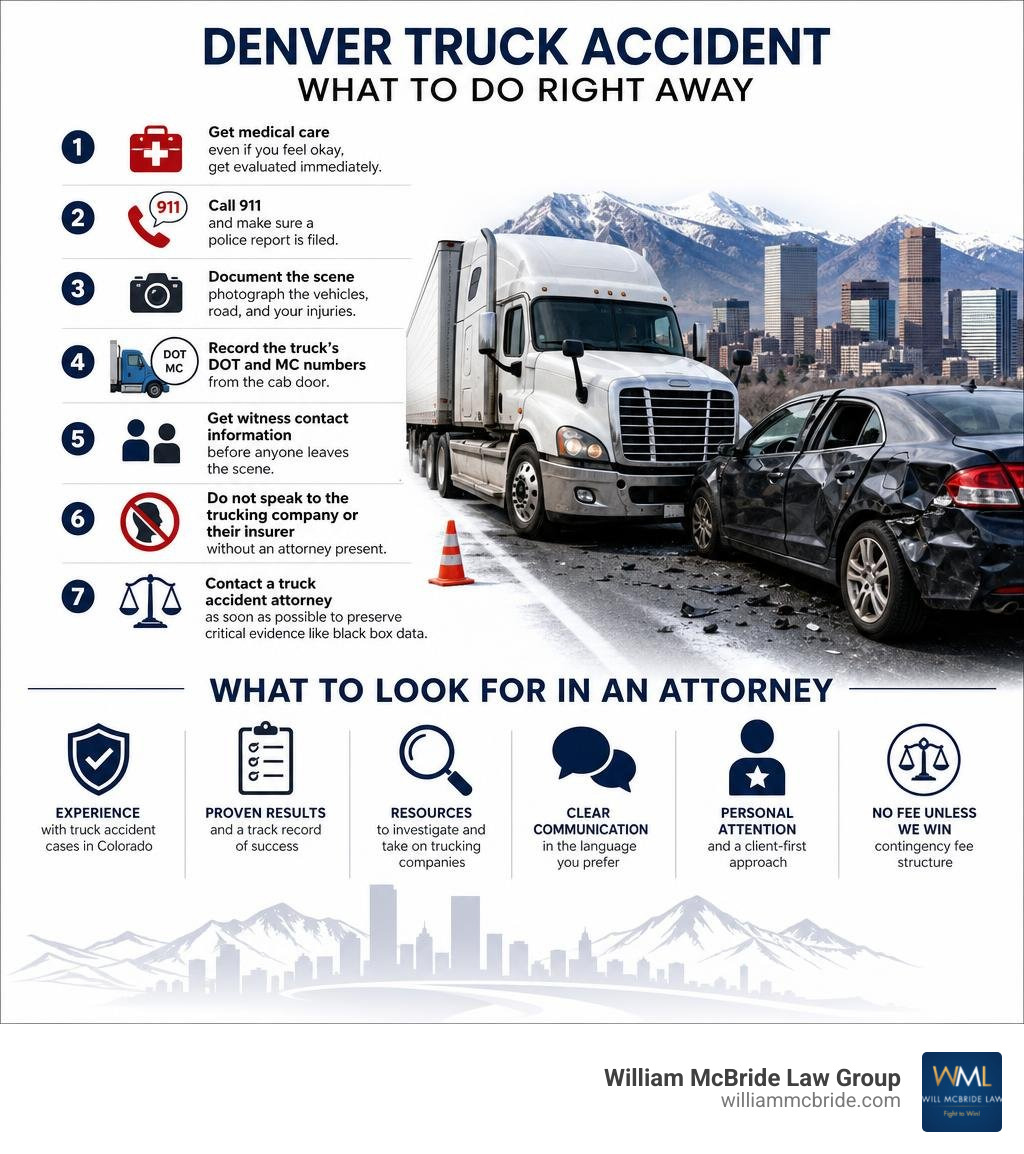
Quick Answer: Steps to Take After a Denver Truck Accident
- Get medical care — even if you feel okay, get evaluated immediately
- Call 911 and make sure a police report is filed
- Document the scene — photograph the vehicles, road, and your injuries
- Record the truck’s DOT and MC numbers from the cab door
- Get witness contact information before anyone leaves the scene
- Do not speak to the trucking company or their insurer without an attorney present
- Contact a truck accident attorney as soon as possible to preserve critical evidence like black box data
Denver sits at the intersection of I-70 and I-25 — two of the busiest commercial freight corridors in the American West. That geography matters. It means tens of thousands of large commercial trucks pass through the metro area every year, sharing lanes with everyday commuters, families, and workers.
When something goes wrong, the consequences are serious.
From 2020 to 2024, Denver County recorded
3,860 truck accidents — more than any other county in Colorado. Statewide, injuries were suspected or confirmed in nearly 1,720 of those crashes. In 2024 alone, 99 people died in crashes involving large commercial trucks in Colorado, according to U.S. Department of Transportation data.
Behind those numbers are real people — many of them working adults who woke up that morning with no idea their lives were about to change.
A truck accident is not like a fender-bender with another car. A fully loaded semi can weigh up to
80,000 pounds — roughly 20 times the weight of a passenger vehicle. The injuries are often catastrophic. The legal process is far more complex. And the companies on the other side typically have experienced legal teams and insurance adjusters ready to respond within hours of a crash.
That is why choosing the right attorney matters so much — and why this guide was written.
Attorney Will McBride, known in the community as
Abogado William, understands what injured people are carrying after a serious crash: medical bills, missed work, pain, and the pressure of not knowing what comes next. Will McBride Law serves clients in English and Spanish —
se habla español — and approaches every case with the preparation and seriousness it deserves.
This checklist will walk you through exactly what to look for in a Denver truck accident attorney, what your rights are under Colorado law, and what steps protect your claim from the start.
Why Commercial Truck Accidents in Denver Are Highly Complex
When a standard passenger vehicle collides with another car, the legal process is relatively straightforward. Usually, it is a matter of determining which driver made a mistake, exchanging insurance information, and filing a claim.
A commercial
tractor-trailer accident is entirely different. These crashes involve a web of state and federal laws, massive corporate insurance policies, and multiple parties who might share blame for what happened.
First, commercial trucks are governed by the Federal Motor Carrier Safety Administration (FMCSA). These federal rules dictate everything from how many hours a driver can spend behind the wheel without a break to how cargo must be secured. The agency provides public information about commercial carrier safety rules through the
Federal Motor Carrier Safety Administration. Proving that a trucking company or driver violated these rules requires a deep understanding of the transportation industry and how federal safety standards apply to commercial carriers.
Second, the physical forces involved in these collisions are devastating. Because a commercial rig can weigh up to 80,000 pounds on interstate highways, the injuries sustained by occupants of passenger cars are often severe, life-altering, or fatal. Managing the legal side of a catastrophic injury claim requires a lawyer who knows how to calculate future medical costs, lost earning capacity, and long-term care needs to ensure the injured person’s future is protected.
How Colorado Trucking Regulations Impact Liability
In addition to federal regulations, Colorado has its own specific laws that apply to commercial vehicles operating within state lines. The Colorado Department of Transportation (CDOT) and the Colorado State Patrol enforce strict guidelines to keep mountain passes and metro highways safe.
- Commercial Vehicle Definitions: Interestingly, Colorado defines a commercial vehicle more narrowly than the federal government in some instances. While the FMCSA generally regulates vehicles over 10,001 pounds, Colorado state rules can apply specific requirements to commercial vehicles with a Gross Vehicle Weight Rating (GVWR) of 16,000 pounds or more operating in intrastate commerce.
- The I-70 Chain Law: Between September 1 and May 31, all commercial vehicles traveling on I-70 between Morrison (Milepost 259) and Dotsero (Milepost 133) must carry sufficient tire chains. Failure to carry chains, or failure to install them when the chain law is active, is a serious safety violation. If a truck jackknifes on a snowy mountain pass because the driver ignored the chain law, it is strong evidence of negligence.
- Left-Lane Restrictions: To prevent commercial vehicles from blocking traffic and causing hazardous situations on steep mountain climbs, Colorado restricts trucks from using the left lane in several designated highway stretches.
- Port of Entry Inspections: Colorado operates 10 Port of Entry facilities throughout the state to perform commercial vehicle enforcement, checking weights, safety credentials, and mechanical compliance.
When a truck suffers a mechanical failure, such as brake loss or severe
trailer sway, investigators must look closely at whether the truck went through required inspections and whether the driver complied with Colorado’s mountain driving rules.
The Checklist: How to Choose a Truck Accident Attorney in Denver
If you or a loved one has been injured, you should not have to guess about how to find the right legal representation. Use this practical checklist when researching and speaking with a
truck accident attorney in Denver:
- [ ] Do they have a trial-ready approach? Many law firms prefer to settle cases quickly, even if the offer is low, to keep their case volume moving. You want an attorney who prepares every single case as if it is going to trial. When insurance companies know a lawyer is ready to step into a courtroom, they are much more likely to offer a fair settlement.
- [ ] Do they have the resources to fight a trucking company? Investigating a commercial vehicle crash is demanding. It can require accident reconstructionists, safety engineers, medical professionals, and a team that understands how to preserve and analyze commercial trucking evidence.
- [ ] Do they listen to you and treat you with respect? You are a person, not a case number. During your initial consultation, pay attention to whether the attorney answers your questions clearly or tries to rush you out the door.
- [ ] Are they bilingually accessible? If your family feels more comfortable speaking Spanish, you deserve a legal team that can communicate with you directly without relying on outside translators. Will McBride Law proudly serves Spanish-speaking families under the name Abogado William.
- [ ] Are they local and accessible? It helps to have a firm with a physical presence where you can meet face-to-face. You can learn more about finding a local office by visiting our Denver Office page.
Essential Resources for a Truck Accident Attorney in Denver
A successful commercial vehicle claim relies on immediate, thorough investigation. A dedicated attorney must have a network of professional resources ready to deploy right after a crash.
One of the most critical pieces of evidence is the truck’s Electronic Control Module (ECM), commonly known as the “black box.” The black box records vital data in the seconds leading up to a crash, including:
- The speed of the truck
- Whether and when the brakes were applied
- Steering inputs and sudden turns
- Engine RPMs and throttle position
This data is incredibly fragile. In many trucks, the black box only records a limited amount of data before it begins overwriting old files. If the trucking company puts the truck back on the road, the engine restarts can erase the exact data needed to prove fault.
A prepared attorney will immediately send a formal spoliation letter (an evidence preservation letter) to the trucking company, legally demanding that they park the vehicle and preserve all electronic data, driver logs, and maintenance records to prevent critical evidence from being lost or destroyed.
What to Ask During an Initial Consultation
Many people are unsure what to ask when they first speak with an attorney after a serious truck crash. A useful consultation should help you understand the legal process, the evidence that needs to be preserved, and the next steps for protecting your claim.
Consider asking:
- Who will handle the investigation? Truck accident cases often require quick action to preserve black box data, driver logs, maintenance records, and company safety documents.
- How will you identify every responsible party? Liability may involve the driver, motor carrier, maintenance contractor, cargo loader, or another company connected to the truck.
- How will you keep me informed? Clear communication matters, especially when medical care, missed work, and insurance pressure are happening at the same time.
To learn more about the kinds of injury matters the firm handles, you can explore our
Practice Areas page.
Determining Liability and Recovering Compensation in Colorado
One of the reasons commercial vehicle crashes are so legally challenging is that liability is rarely limited to the driver. Depending on the facts of the crash, multiple corporate entities may share responsibility:
- The Trucking Company (The Motor Carrier): Under the legal doctrine of respondeat superior, employers are generally responsible for the negligent actions of their employees while on the job. Additionally, a trucking company can be held directly liable for negligent hiring, failing to train drivers, or forcing drivers to exceed their legal hours of service.
- The Cargo Loading Company: If a trailer is loaded improperly, the cargo can shift during a turn. This shifting weight can cause the driver to lose control, leading to jackknife or rollover accidents.
- Maintenance Contractors: Trucking companies often outsource their fleet maintenance. If a third-party mechanic fails to repair worn brakes or ignored a critical safety issue, they may share liability.
- Parts Manufacturers: If a tire blowout or brake failure was caused by a manufacturing defect, the company that designed or built the part can be held responsible.
Understanding these differences is easier when comparing them directly to a standard car crash.
| Feature |
Passenger Car Accident |
Commercial Truck Accident |
| Typical Weight |
3,000 to 5,000 lbs |
Up to 80,000 lbs |
| Primary Regulations |
Colorado Motor Vehicle Code |
FMCSA Federal Rules + State CDOT Rules |
| Liable Parties |
Usually just the driver |
Driver, carrier, loader, manufacturer, etc. |
| Insurance Policies |
Typically $25,000 to $100,000 |
Often $750,000 to $5,000,000+ |
| Evidence Needed |
Police report, photos, basic statements |
Black box, driver logs, maintenance audits, GPS |
If you want to understand how standard traffic accidents are handled, you can read about our approach to
Auto Accidents.
Critical Evidence Needed to Prove Fault
To build a strong case, an attorney must look far beyond the basic police report. Proving negligence in a commercial truck crash requires gathering and analyzing specialized documentation:
- Electronic Logging Devices (ELDs): Modern trucks use ELDs to automatically record a driver’s hours of service. Comparing these logs against toll receipts, fuel stops, and GPS data can reveal if a driver falsified their records to drive longer than legally allowed. This is especially critical in cases involving fatigued or Drunk Drivers.
- Driver Qualification Files: Trucking companies are required to keep detailed files on their drivers, including road test results, medical examiner certificates, annual driving records, and drug and alcohol testing history.
- Post-Crash Drug and Alcohol Tests: Federal law requires commercial drivers to undergo chemical testing immediately following certain types of serious accidents.
- Maintenance and Inspection Reports: Drivers must complete daily vehicle inspection reports, and carriers must keep systematic maintenance logs. If a truck was operated with known mechanical defects, it shows a clear disregard for public safety.
Statute of Limitations and Recoverable Damages in Colorado
Under Colorado Revised Statutes § 13-80-101, the statute of limitations for personal injury claims arising from motor vehicle accidents is
three years from the date of the crash. If a crash results in a tragic loss of life, the family has
a shorter time from the date of death to file a wrongful death claim. Failing to file within these strict deadlines means losing your legal right to seek compensation. You can read more about how these painful situations are handled on our
Wrongful Death and
Wrongful Death Auto informational pages.
When filing a claim, injured victims can seek compensation for several types of damages:
- Economic Damages: These are verifiable financial losses, including past and future medical bills, rehabilitation costs, lost wages, and loss of earning capacity.
- Non-Economic Damages: These cover subjective losses, such as physical pain and suffering, emotional distress, PTSD, and loss of enjoyment of life. Colorado places statutory caps on non-economic damages. For accidents occurring in 2026, the cap on non-economic damages in standard personal injury cases is approximately $1.5 million, while the wrongful death cap is around $2.125 million.
- Physical Impairment and Disfigurement: Under Colorado law, damages for permanent physical impairment or severe scarring are legally separate and are not subject to the standard non-economic damages caps.
Frequently Asked Questions About Denver Truck Accidents
The first priority is always physical safety. Seek medical evaluation immediately, even if you do not feel severe pain right away — adrenaline can mask serious internal injuries or concussions.
If it is safe to do so at the scene, take photos of the damage to all vehicles, the positioning of the truck, skid marks, road conditions, and any visible injuries. Exchange basic contact and insurance information, and make sure to write down the truck’s DOT and MC numbers, which are usually printed on the side of the cab.
Avoid discussing who was at fault with the truck driver or their insurance representatives, as these statements can be used to minimize your claim later. If you were involved in a crash involving multiple vehicles, you can read our guide on how to handle a
Multiple Car Pile Up.
Can I still recover compensation if I was partially at fault?
Yes. Colorado follows a
modified comparative negligence rule (specifically the 50 percent bar). This means you can still recover compensation as long as your share of the responsibility for the crash is
less than 50 percent.
However, your recovery will be reduced by your percentage of fault. For example, if a jury determines your total damages are $100,000, but finds you were 20 percent at fault for the accident, your final award will be reduced to $80,000. If you are found to be 50 percent or more at fault, you cannot recover any compensation under Colorado law.
Will my truck accident case have to go to trial?
Most personal injury cases are resolved through settlement negotiations before ever stepping foot in a courtroom. Settling out of court is often faster, less stressful, and provides a predictable outcome for families.
However, a fair settlement usually comes from thorough preparation. If the trucking company’s insurance provider refuses to offer a settlement that fully covers your medical needs and lost wages, your attorney should be prepared to file a lawsuit and present your case to a jury.
Conclusion
A serious commercial truck crash can leave you feeling overwhelmed, financially stressed, and uncertain about your family’s future. You do not have to carry that burden alone, and you do not have to guess about what steps to take next.
Attorney Will McBride and the team at Will McBride Law believe that ordinary people deserve respect, honest communication, and a dedicated advocate when they have been harmed by corporate negligence. Known in the community as
Abogado William, he prepares every case with the discipline and readiness required to stand up to major trucking operations and their insurers. Whether you prefer to communicate in English or Spanish, the firm is here to listen to your story.
Anyone injured in a serious collision should not have to navigate this complex process without support. Attorney Will McBride offers case reviews to help you understand your legal options, protect your rights, and make informed decisions for your family’s future.
If you are ready to speak with a dedicated advocate,
schedule a consultation for tractor-trailer accidents today.
Disclaimer: The information provided in this article is for general educational purposes only and does not constitute formal legal advice. Case outcomes depend entirely on the unique facts and evidence of each individual situation.
Illustrations are for dramatization purposes only.