When a Truck Crash Turns Your Life Upside Down
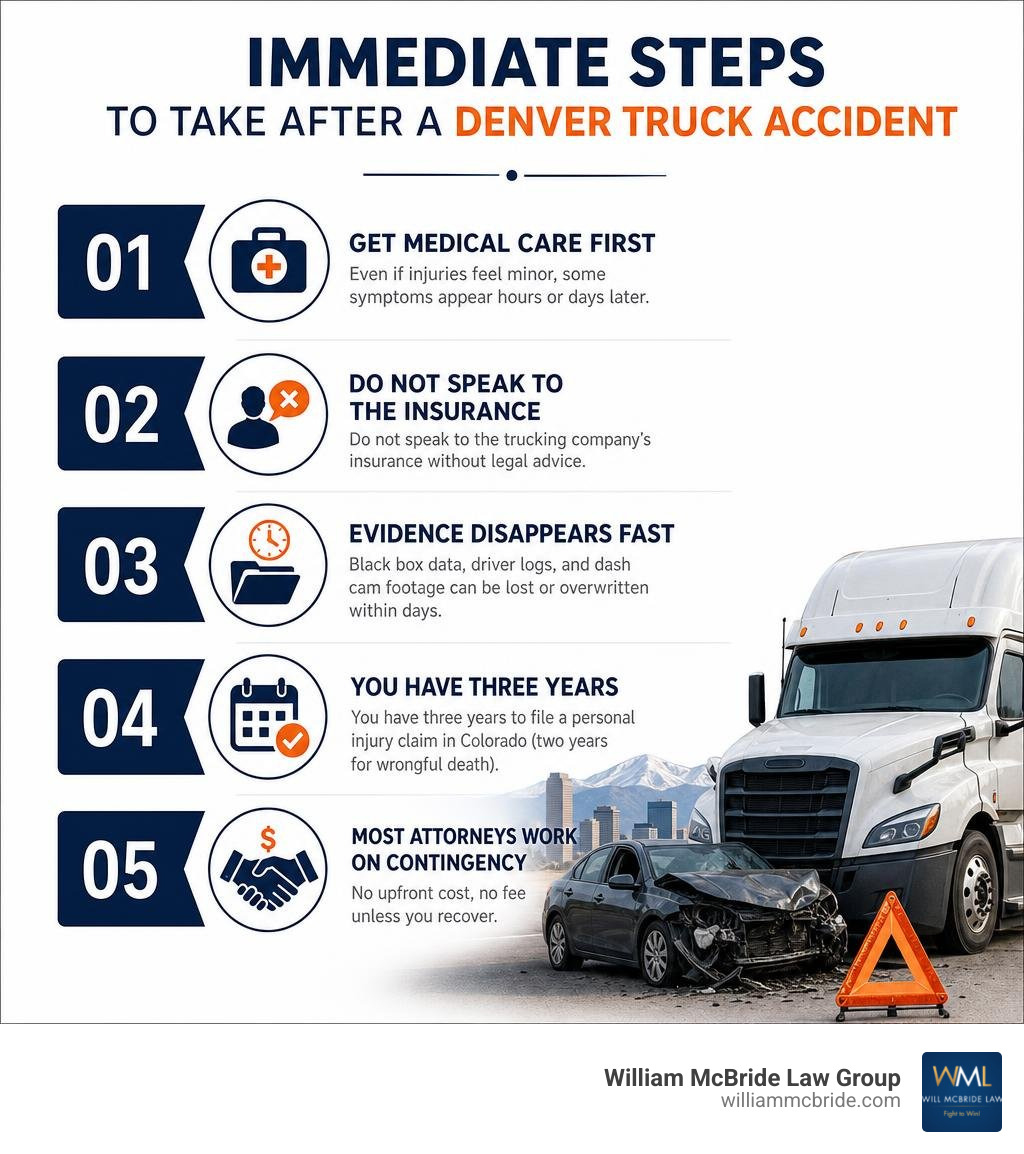
If you’ve been involved in a truck accident, here’s what you need to know to protect your rights and strengthen your claim.
- Get medical care first — even if injuries feel minor, some symptoms appear hours or days later
- Do not speak to the trucking company’s insurance without legal advice
- Evidence disappears fast — black box data, driver logs, and dash cam footage can be lost or overwritten within days
- You have three years to file a personal injury claim in Colorado (two years for wrongful death)
- Most truck accident attorneys work on contingency — no upfront cost, no fee unless you recover
Truck accidents on Colorado’s busiest freight corridors, including I-25 and I-70, are rarely “minor.” A fully loaded semi-truck can weigh up to 80,000 pounds, far more than the average passenger vehicle. When that force hits a car, victims may suffer life-changing injuries like spinal cord damage, traumatic brain injuries, multiple fractures, and other catastrophic harm.
The financial pressure hits just as hard. Medical bills pile up. Paychecks stop. And within hours of the crash, the trucking company’s legal and insurance teams may already be working to protect their interests — not yours.
That gap — between what injured people face and what powerful companies do — is exactly why having the right legal support matters so much.
Attorney Will McBride and the team at Will McBride Law Group understand that behind every truck accident case is a real person: someone trying to heal, pay bills, and figure out what comes next. The goal is not to overwhelm you with legal complexity. It is to help you understand your rights, protect your claim, and pursue the compensation Colorado law may allow.
Denver Truck Accident Lawyer: What to Do After a Commercial Truck Crash

When a standard passenger vehicle is involved in a collision, the legal process is usually straightforward. Typically, two drivers are involved, their respective insurance companies exchange information, and a settlement is reached based on relatively clear-cut rules of the road.
Commercial truck collisions are entirely different. Because of the sheer size, weight, and physics of these vehicles, the devastation they leave behind is unmatched on Colorado highways.
A fully loaded semi-truck traveling at highway speeds requires the length of nearly two football fields to come to a complete stop. When a truck driver is distracted, fatigued, or operating a vehicle with faulty brakes, that stopping distance increases exponentially.
When a collision occurs, the occupants of smaller passenger vehicles bear the brunt of the impact. This disparity in size and weight is why victims frequently suffer catastrophic, life-altering injuries.
Navigating the aftermath of such a crash requires specialized knowledge. An experienced Truck Accident Lawyer in Denver understands the unique challenges of these claims. Unlike typical Auto Accidents, commercial truck crashes involve a complex web of federal safety regulations, corporate policies, and multi-million-dollar insurance coverages.
Trying to handle these details alone while recovering from severe physical trauma can place an immense burden on a family. A dedicated attorney helps level the playing field, allowing the injured person to focus entirely on healing.
When to Hire a Denver Semi-Truck Accident Lawyer
In the hours immediately following a commercial vehicle crash, the trucking company and its insurer will often deploy a “Rapid Response Team” to the scene. These are investigators, reconstructionists, and corporate lawyers whose primary job is to gather evidence that minimizes the company’s liability. They may take photos, interview witnesses, and analyze the physical damage with the sole goal of building a defense.
To counter this immediate corporate action, victims should seek legal counsel as quickly as possible. An attorney can step in immediately to issue formal preservation letters. These letters legally obligate the trucking company to preserve critical, time-sensitive evidence, such as:
- The truck’s Electronic Control Module (ECM) or “black box” data
- The driver’s hours-of-service (HOS) logs
- In-cab camera footage and dispatch records
- Post-crash drug and alcohol testing results
For Spanish-speaking families, having access to bilingual legal support is vital during this stressful time. Known publicly as Abogado William, Attorney Will McBride ensures that language is never a barrier to justice. Families can access a dedicated Abogado de Accidentes de Camiones en Denver to ensure their voices are heard and their rights are fully protected.
The Physical and Financial Toll of Semi-Truck Wrecks
The physical consequences of a semi-truck crash are often catastrophic. Victims frequently sustain severe injuries such as traumatic brain injuries (TBIs), spinal cord damage resulting in paralysis, internal organ damage, severe burns, and orthopedic fractures. These injuries do not just require a single hospital visit; they often demand a lifetime of specialized medical care, physical therapy, and home modifications.
The financial toll can quickly become overwhelming. According to commercial trucking accident statistics in Colorado:
- In 2024 alone, 585 people were injured and 98 people were killed in commercial trucking accidents across the state.
- As of June 18, 2025, CDOT recorded 2,233 truck accidents in 2025, with 164 resulting in injury and 5 being fatal.
- From 2020 to 2024, Denver County recorded the highest concentration of commercial truck accidents in the state, with 3,860 crashes.
When a collision results in the ultimate tragedy, surviving family members have the legal right to seek accountability through a Wrongful Death claim. While no amount of financial compensation can replace a loved one, it can help secure a family’s financial future by covering funeral costs, medical debts, and the loss of the deceased’s future income and support.
Identifying Liable Parties in a Commercial Vehicle Crash
One of the most complex aspects of a commercial truck accident is determining who is responsible. In a typical passenger vehicle crash, liability usually rests with one of the drivers. In a trucking accident, however, multiple corporate entities may share the blame.
Identifying all responsible parties is a critical step in securing fair compensation. Because commercial trucking operations involve various independent contractors, brokers, and manufacturers, a thorough investigation is required to untangle the relationships between these entities.
A dedicated legal team will carefully analyze shipping contracts, lease agreements, and employment records to determine which parties can be held accountable under Colorado law.
Truck Drivers and Trucking Companies
The most direct line of liability often points to the truck driver and their employer. Truck drivers may cause accidents due to:
- Driver Fatigue: Despite strict federal regulations limiting driving hours, some drivers face immense pressure from employers to meet unrealistic delivery deadlines, leading them to drive while exhausted.
- Distracted or Impaired Driving: Using mobile devices, navigating complex GPS systems, or operating under the influence of drugs or alcohol.
- Speeding and Aggressive Driving: Driving too fast for weather conditions, especially on steep mountain passes like the I-70 corridor.
Under the legal doctrine of respondeat superior, trucking companies can be held liable for the negligent actions of their employees while on duty. Additionally, trucking companies can be held directly liable for their own negligent practices, such as:
- Negligent Hiring: Failing to conduct background checks, verify commercial driver’s licenses (CDLs), or review a driver’s safety history.
- Inadequate Training: Sending inexperienced drivers onto challenging mountain terrains without proper instruction.
- Forcing Hours-of-Service Violations: Encouraging or turning a blind eye to falsified logbooks to keep trucks on the road longer than legally permitted.
Third-Party Liability: Shippers, Manufacturers, and Maintenance Crews
Beyond the driver and the carrier, third-party entities often play a hidden role in causing a crash. These include:
- Cargo Shippers and Loaders: If cargo is improperly secured or overloaded, it can shift during transit. This shift can cause the driver to lose control, leading to catastrophic jackknife or rollover accidents.
- Maintenance Providers: Commercial trucks travel tens of thousands of miles every year, putting extreme wear on their parts. If an independent maintenance contractor fails to inspect, repair, or replace worn brake pads, steering components, or tires, they can be held liable for a mechanical failure on the road.
- Parts Manufacturers: If a crash is caused by a defective component—such as a sudden tire blowout or a brake failure on a steep grade—the manufacturer of that defective part may be held responsible through a product liability claim.
Critical Evidence and Regulations in Colorado Truck Accident Injury Claims
Proving negligence in a commercial trucking case requires a careful understanding of industry-specific technology and record-keeping. Because trucking companies are highly regulated, they generate large amounts of data. However, this data is only helpful if an attorney knows how to secure and analyze it before it is lost or destroyed.
Regardless of where an accident occurs, the core of a successful claim rests on the swift preservation of physical and digital records. Acting quickly helps ensure that critical evidence is not overwritten, discarded, or difficult to locate later.
How a Denver Trucking Injury Attorney Proves Negligence
To build a strong case, a denver trucking injury attorney will immediately initiate a comprehensive investigation. This may involve working with accident reconstruction professionals, forensic engineers, and safety specialists to piece together exactly what happened. Key pieces of evidence include:
- The Electronic Control Module (ECM): Often referred to as the truck’s “black box,” this device records critical telemetry data in the seconds leading up to a crash, including vehicle speed, brake application, throttle position, and engine RPMs.
- Electronic Logging Devices (ELDs): Modern trucks use ELDs to automatically record a driver’s hours of service. Comparing these digital logs with toll receipts, GPS data, and fuel purchases can reveal whether a driver may have been operating beyond legal safety limits.
- Maintenance and Inspection Records: Federal law requires daily vehicle inspection reports. Reviewing these logs can help show whether a trucking company ignored known mechanical issues to keep a truck in service.
- Spoliation Letters: An attorney will send a formal spoliation letter to the trucking company immediately after being retained. This legal notice warns the carrier that records related to the truck, driver, or crash must be preserved.
Federal and State Trucking Regulations
Commercial trucking is governed by a strict set of rules established by the Federal Motor Carrier Safety Administration. These regulations address issues such as driver hours, vehicle inspections, maintenance obligations, licensing requirements, and minimum liability insurance coverage. For example, while standard Colorado auto policies may only require $25,000 in bodily injury liability, federal law requires many interstate freight carriers to carry at least $750,000 in liability coverage, with higher limits for certain hazardous materials.
In addition to federal rules, Colorado has specific state laws designed to address its unique mountainous terrain:
- The Colorado Chain Law: Commercial vehicles traveling on I-70 between Morrison and Dotsero must carry sufficient tire chains from September 1 to May 31 and deploy them when winter traction laws are active. Failing to follow chain requirements may become important evidence if a crash occurs.
- Left Lane Restrictions: State law restricts commercial trucks from using the left lane on certain multi-lane highways and steep mountain grades to prevent slow-moving trucks from blocking traffic and causing rear-end collisions.
- Colorado Weight Limits: The maximum gross weight for commercial vehicles is 80,000 pounds on interstate highways. Overloaded trucks put dangerous strain on braking systems, especially when descending steep mountain passes.
Colorado Trucking Laws, Statute of Limitations, and Damages Caps
Understanding how Colorado law treats commercial truck claims is essential for protecting your right to recovery. The legal system handles these cases differently than standard passenger vehicle accidents, applying distinct timelines, fault rules, and monetary caps.
| Legal Element | Standard Colorado Car Accident | Colorado Commercial Truck Accident |
|---|---|---|
| Statute of Limitations | 3 Years (C.R.S. § 13-80-101) | 3 Years (C.R.S. § 13-80-101) |
| Primary Regulatory Body | Colorado Dept. of Revenue (DMV) | FMCSA & Colorado State Patrol |
| Minimum Liability Insurance | $25,000 per person / $50,000 per accident | $750,000 to $5,000,000+ (Federal Standard) |
| Common Liable Parties | Individual Driver | Driver, Carrier, Shipper, Manufacturer |
| Key Evidence Types | Police Report, Photos, Witness Statements | Black Box, ELD Logs, Maintenance Files, CDL Files |
Colorado operates under a modified comparative negligence system with a 50% bar. This means an injured victim can recover damages as long as they are less than 50% at fault for the accident. However, the recovered amount will be reduced by their percentage of fault. For example, if a jury determines a victim suffered $100,000 in damages but was 20% at fault for the crash, the final recovery would be reduced to $80,000. If the victim is found to be 50% or more at fault, they are legally barred from recovering any compensation.
Colorado also imposes statutory caps on certain types of compensation:
- Non-Economic Damages: These damages cover subjective, non-monetary losses such as pain and suffering, emotional distress, and loss of enjoyment of life. For claims arising after January 1, 2025, Colorado caps non-economic damages at $1.5 million (with adjustments for inflation scheduled to begin in 2028).
- Wrongful Death Damages: In cases involving a fatality, non-economic wrongful death damages are capped at $2.125 million for claims filed after January 1, 2025.
- The Physical Impairment Exception: Crucially, Colorado law provides an exception to these caps. If a victim suffers permanent physical impairment or blindness, the statutory caps on non-economic damages do not apply. This is an important distinction for victims of catastrophic truck accidents who face lifelong disabilities.
Determining the true value of a claim requires analyzing medical records, future care plans, and economic impacts. An experienced attorney can help calculate these damages to ensure that any settlement offer fully accounts for both immediate expenses and long-term care needs.
Frequently Asked Questions About Denver Truck Accidents
The aftermath of a commercial vehicle collision is often filled with confusion and stress. Below are clear, straightforward answers to some of the most common questions victims and their families ask.
What damages can be recovered after a truck accident?
Victims of commercial truck accidents may be entitled to recover both economic and non-economic damages.
- Economic damages cover verifiable financial losses, including past and future medical bills, rehabilitation costs, lost wages, loss of earning capacity, and property damage.
- Non-economic damages compensate for intangible losses, such as physical pain and suffering, mental anguish, PTSD, physical disfigurement, and loss of consortium (companionship).
- In rare cases involving willful or reckless conduct—such as a trucking company consciously allowing an impaired driver on the road—punitive damages may be pursued to punish the wrongdoer and deter similar behavior in the future.
How long do I have to file a truck accident claim in Colorado?
Under Colorado Revised Statutes § 13-80-101, the statute of limitations for personal injury claims arising from motor vehicle accidents is three years from the date of the crash. If a loved one lost their life in the accident, the timeline for a wrongful death claim is shorter—two years from the date of death.
While three years may seem like a long time, waiting can be highly damaging to a case. Physical evidence at the crash scene fades, witnesses move or forget details, and trucking companies are only required to keep certain records for a limited time. Contacting an attorney promptly ensures that critical evidence is preserved immediately.
How do contingency fees work for truck accident lawyers?
Most personal injury lawyers, including the team at William McBride Law Group, operate on a contingency fee basis. This means there are no upfront costs or hourly fees for the client. The attorney’s fees are paid as a percentage of the final settlement or jury verdict.
If the attorney does not successfully recover compensation for the case, the client owes no attorney’s fees. This arrangement ensures that high-quality legal representation is accessible to everyone, regardless of their financial situation, allowing families to stand up to well-funded trucking corporations without financial risk.
Conclusion: Protecting Your Rights on Colorado Roads
A commercial truck accident can reshape a family’s life in a matter of seconds. Facing the physical pain of recovery, the stress of mounting medical bills, and the aggressive tactics of corporate insurance adjusters is not something anyone should have to do alone.
Attorney Will McBride and the William McBride Law Group are dedicated to helping ordinary families navigate these complex legal challenges. With a strong commitment to preparation, discipline, and trial readiness, the firm works diligently to protect the rights of injured individuals and hold negligent corporations accountable.
Because justice should be accessible to everyone in our community, the firm provides compassionate, bilingual services. Se habla Español.
If you or a loved one has been injured in a commercial vehicle crash, you do not have to guess about your next steps or face powerful insurance companies alone. We invite you to reach out to our Contact Denver Office today to schedule a free, confidential case review. To learn more about our approach to handling commercial vehicle collisions, please visit our detailed guide on tractor-trailer accidents.
Disclaimer: The information provided in this article is for general educational purposes only and does not constitute formal legal advice. Any dramatizations are for illustrative purposes only. Case outcomes depend entirely on the unique facts and circumstances of each individual matter.