When a Walk Turns Dangerous: What Denver Pedestrians Need to Know After an Accident
If you or someone you love was struck by a vehicle and you need a Denver pedestrian accident lawyer, here is what matters most right away:
Quick answers for injured pedestrians in Denver:
- Get medical care first — even if injuries feel minor, see a doctor the same day
- Call 911 — get a police report filed at the scene
- Do not give a recorded statement to any insurance company before speaking with an attorney
- Colorado gives you three years to file a personal injury claim (only 182 days if a government vehicle was involved)
- You may still recover compensation even if you were partially at fault — as long as your fault is less than 50%
- A free case review with a pedestrian accident attorney costs nothing and protects your rights from day one
Denver is a city built for people on the move. Residents walk to work, to restaurants, to parks, and along corridors like the 16th Street Mall and Colfax Avenue every single day. But those same streets can be dangerous.
In 2023, Colorado recorded a record high for pedestrian accidents and fatalities — 128 people lost their lives. Denver alone accounts for nearly 25% of Colorado’s pedestrian deaths. That is not a statistic to scroll past. Behind every number is a real person — someone’s parent, partner, or child — dealing with serious injuries, mounting medical bills, and a future that suddenly looks very uncertain.
Being hit by a car while walking is a physically devastating and emotionally disorienting experience. The days after a crash are often filled with pain, confusion, and pressure from insurance companies that move fast and act in their own interest.
Attorney Will McBride — known in the community as Abogado William — understands what injured people are facing. Will McBride Law Group works with everyday working adults and families across Denver who need someone in their corner: someone who will take the case seriously, communicate clearly, and be ready to fight when the other side will not do the right thing. Se habla español.
Understanding Denver Pedestrian Accidents: Causes and Alarming Statistics

To understand the scope of the problem in Denver, it helps to look at the Colorado numbers. Pedestrian deaths are not just a national concern. They are rising sharply here at home. According to CDOT, Colorado pedestrian fatalities have increased 77% since 2018, a troubling trend that shows how dangerous everyday walking can be on busy streets and intersections.
Though many communities want to make their streets safer for pedestrians and cyclists, streets remain dangerous for them. In 2023, pedestrian deaths accounted for 19% of all Colorado traffic fatalities with 135 deaths, compared with 126 passenger vehicle fatalities and 113 motorcycle fatalities, according to Colorado Department of Transportation data. In 2013, there were 54 pedestrian fatalities, accounting for 11% of all traffic deaths. Colorado pedestrian deaths skyrocket. There is no end in sight.
Because Denver is the state’s most densely populated urban center, it bears a disproportionate share of this burden. Denver regularly accounts for nearly 25% of all pedestrian deaths in Colorado. High-traffic corridors such as Federal Boulevard, Colfax Avenue, and Broadway see some of the highest rates of pedestrian injuries.
To address this crisis, Denver adopted the Vision Zero initiative in 2016. This program aims to eliminate traffic deaths and serious injuries by restructuring roadways, lowering speed limits, and utilizing data-driven safety measures. While progress has been made in certain neighborhoods, the reality on the ground remains dangerous for those traveling on foot.
Common Causes of Pedestrian Crashes in Colorado
Why are pedestrian accidents in Denver continuing to rise? Several key factors contribute to these dangerous collisions:
- Distracted Driving: The widespread use of smartphones is one of the single largest drivers of pedestrian accidents. Drivers looking at text messages, navigation apps, or social media fail to notice pedestrians crossing the street, even when those pedestrians have a clear walk signal.
- Impaired Drivers: Driving under the influence of alcohol or drugs remains a major threat. Approximately 30% of fatal pedestrian accidents involve alcohol. Whether it is the driver or the pedestrian who is impaired, alcohol significantly slows reaction times and impairs judgment.
- Failure to Yield at Crosswalks: Many drivers fail to look for pedestrians when making right or left turns at intersections. They may focus entirely on oncoming traffic and pull directly into the path of a pedestrian who has the legal right-of-way.
- Poor Lighting and Dark Conditions: Pedestrian accidents occur more frequently between 6 p.m. and midnight. Poorly lit street corners, dark clothing, and seasonal weather changes make pedestrians highly vulnerable during these hours.
- Increasing Vehicle Size: The growing popularity of large SUVs and light trucks has made pedestrian collisions far more lethal. Because of their higher front-end profiles, these vehicles strike pedestrians in the chest and head rather than the legs, leading to much more severe trauma.
- Inadequate Infrastructure: Many areas in Denver lack sufficient sidewalks, marked crosswalks, or pedestrian refuge islands, forcing people to walk along shoulders or cross multi-lane highways without protection.
When drivers behave recklessly, the consequences are borne entirely by the unprotected person on the street. If you have been injured by a careless motorist, reaching out to a denver pedestrian accident lawyer is a critical step toward holding them accountable.
Severe Injuries Sustained in Pedestrian Collisions
Unlike occupants of a passenger vehicle, a pedestrian has no steel frame, airbags, or seatbelts to absorb the force of a collision. When a multi-ton vehicle strikes a human body, the injuries are almost always severe and life-altering.
These collisions often involve a “two-impact” sequence: first, the vehicle strikes the pedestrian, and second, the pedestrian is thrown onto the hood, windshield, or the hard asphalt of the road. This secondary impact often causes injuries just as severe as the initial crash.
Some of the most common and devastating Pedestrian Injuries include:
- Traumatic Brain Injuries (TBIs): Ranging from concussions to severe cognitive impairment, brain injuries can alter a person’s personality, memory, and physical capabilities permanently.
- Spinal Cord Injuries and Paralysis: Damage to the spine can lead to temporary or permanent loss of motor function, paraplegia, or quadriplegia, requiring lifetime medical care and home modifications.
- Bone Fractures: Pedestrians often suffer broken pelvises, shattered femurs, and fractured wrists or arms as they instinctively try to brace for the impact.
- Internal Organ Damage: Blunt force trauma can cause internal bleeding, collapsed lungs, and ruptured organs that require emergency, life-saving surgery.
- Soft Tissue Damage and “Road Rash”: Severe lacerations, torn ligaments, and deep muscle bruising can lead to chronic pain and limit mobility for months or years.
- Scarring and Disfigurement: Road rash and deep cuts can leave permanent, painful scars that require reconstructive plastic surgery and cause deep emotional distress.
These injuries do not just cause physical pain; they lead to massive medical bills, weeks or months of missed work, and immense emotional strain on the victim’s family. Understanding your legal rights is the first step toward reclaiming your stability.
Colorado Pedestrian Laws and Determining Liability
To build a strong legal claim, it is essential to understand how Colorado law governs the interactions between motorists and pedestrians. Many people assume that the pedestrian always has the right-of-way, but the legal reality is more nuanced. Both drivers and pedestrians have specific duties under state and local laws.
| Driver Duties under Colorado Law | Pedestrian Duties under Colorado Law |
|---|---|
| Must yield to pedestrians in marked and unmarked crosswalks (C.R.S. § 42-4-802). | Must obey official traffic control signals and walk displays. |
| Must exercise “due care” to avoid colliding with any pedestrian on a roadway. | Must not suddenly leave a curb or walk into the path of a moving vehicle. |
| Must not pass another vehicle that has stopped to allow a pedestrian to cross. | Must yield the right-of-way to vehicles when crossing outside of a crosswalk. |
| Must yield when crossing sidewalks, driveways, and alleys. | Must use sidewalks where they are provided and safe to use. |
Under Colorado Revised Statutes (C.R.S.) § 42-4-802, drivers must yield the right-of-way to pedestrians who have already entered a crosswalk. This applies to both marked crosswalks (painted lines on the road) and unmarked crosswalks (which exist at any standard intersection where sidewalks meet, regardless of whether lines are painted).
Additionally, Denver Revised Municipal Code § 54-231 establishes strict protections for pedestrians within the city limits, placing a heavy burden of care on drivers to remain vigilant, particularly in school zones, parking lots, and highly trafficked commercial districts.
How a Denver Pedestrian Accident Lawyer Establishes Fault
To recover compensation after a crash, the injured pedestrian must prove that the driver was negligent. Negligence means the driver failed to act with the level of care that a reasonably prudent person would use under similar circumstances.
Establishing fault in Denver can be complicated because insurance companies frequently try to shift the blame onto the pedestrian. They may claim that you were “jaywalking,” looking at your phone, or stepping into the street too quickly. This is where Colorado’s modified comparative negligence rule comes into play.
Under C.R.S. § 13-21-111, an injured person can still recover damages as long as their share of the fault is less than 50%. However, their total compensation will be reduced by their percentage of responsibility. For example, if a jury determines that your total damages are $100,000, but finds you were 20% at fault for crossing outside a crosswalk, your final recovery will be reduced to $80,000. If you are found to be 50% or more at fault, you are barred from recovering any compensation at all.
Because of this rule, insurance adjusters work hard to pin even a small percentage of fault on you. An experienced denver pedestrian accident lawyer knows how to counter these tactics by gathering and preserving critical evidence immediately after the crash.
Essential evidence to gather for your claim:
- Police reports and any citations issued to the driver
- Surveillance footage from nearby businesses, traffic cameras, or RTD public transit buses
- The driver’s cell phone records (to prove distraction)
- Physical evidence from the scene, such as skid marks, vehicle debris, and damaged personal items
- Statements from eyewitnesses who saw the collision occur
- Black box data (event data recorders) from the vehicle to show speed and braking patterns
- Medical records detailing the entry angle and mechanics of your physical injuries
By acting quickly, Attorney Will McBride and his team ensure this vital information is not lost or destroyed by the insurance company.
Types of Damages Available to Injured Pedestrians
When a pedestrian is injured due to a driver’s negligence, they have the right to pursue financial compensation for their losses. These losses, legally referred to as damages, are divided into economic and non-economic categories:
Economic Damages (Calculable Financial Losses):
- Medical Expenses: Coverage for emergency room visits, hospital stays, surgeries, diagnostic tests, medications, physical therapy, and any anticipated future medical care.
- Lost Wages: Compensation for the income lost while recovering from your injuries, including missed bonuses or paid time off.
- Loss of Earning Capacity: If your injuries leave you with a permanent disability that prevents you from returning to your previous job, you can pursue compensation for your lost future livelihood.
Non-Economic Damages (Subjective, Non-Financial Losses):
- Pain and Suffering: Compensation for the physical pain and physical discomfort caused by the crash and subsequent medical treatments.
- Emotional Distress: Damages for anxiety, depression, post-traumatic stress disorder (PTSD), and sleep disturbances following the traumatic event.
- Loss of Quality of Life: Compensation for the inability to enjoy hobbies, sports, and daily activities that you participated in before the accident.
In tragic cases where an accident results in a wrongful death, surviving family members can pursue compensation for funeral costs, loss of financial support, and loss of companionship.
It is important to note that Colorado places statutory caps on certain types of damages. For instance, under C.R.S. § 13-21-102.5, non-economic damages are subject to legal limits, which were adjusted to $1.5 million as of January 2025. Working with an attorney who understands these complex statutory limits ensures you are pursuing the full recovery allowed under state law.
If you were hit by a driver who fled the scene (a hit-and-run) or who does not have adequate insurance, you may still have options. Your attorney can help you file a claim under your own Uninsured/Underinsured Motorist (UM/UIM) coverage, which protects you even when you are walking rather than driving.
How a Denver Pedestrian Accident Lawyer Protects Your Rights
Navigating a personal injury claim while trying to heal from severe physical trauma is incredibly stressful. Insurance adjusters are trained to settle claims quickly and for as little money as possible. They may offer an immediate, lowball settlement before you even know the full extent of your medical needs.
Having a dedicated advocate on your side changes the dynamic completely. A denver pedestrian accident lawyer handles all communication with the insurance companies, manages the complex legal paperwork, and builds a compelling case backed by evidence.
At the William McBride Law Group, the approach is rooted in serious preparation and trial readiness. Attorney Will McBride does not rely on quick, high-volume settlements that leave clients with unpaid bills. Instead, the firm prepares every case as if it is going to trial. This disciplined approach shows insurance companies that you will not be intimidated into accepting an unfair offer.
Furthermore, because our community is diverse, we provide full legal services in both English and Spanish. Our Spanish-speaking clients can discuss their cases directly and comfortably in their preferred language. Se habla español.
How does a Denver pedestrian accident lawyer help with my case?
An attorney provides invaluable support by managing the complex investigative and administrative tasks of your claim, including:
- Accident Reconstruction: Working with specialized engineers to recreate the crash scene, proving variables like driver speed, braking distance, and visibility.
- Witness Testimony: Locating and interviewing individuals who witnessed the crash to secure their statements before their memories fade.
- Insurance Communication: Handling all phone calls, emails, and negotiations with insurance adjusters so you can focus on your recovery.
- Evaluating Future Costs: Partnering with medical and economic specialists to calculate the lifetime cost of your medical care and lost wages.
- Navigating Complex Claims: Helping you understand why you may need a car accident lawyer in Denver Colorado to handle multi-vehicle crashes, commercial truck accidents, or disputes over insurance coverage limits.
Whether negotiating a settlement or presenting your case to a jury in a Denver court, having a trial-ready advocate ensures your voice is heard.
What if I was hit outside of a crosswalk or accused of jaywalking?
One of the most common defenses used by insurance companies is pointing out that the pedestrian was not in a marked crosswalk. They may accuse you of jaywalking to deny your claim entirely.
However, being outside of a crosswalk does not automatically make you responsible for the crash. Under Colorado law, drivers always have a legal duty to exercise “due care” to avoid hitting pedestrians. If a driver was speeding, texting, driving under the influence, or ignoring road conditions, they can still be held liable, even if you were crossing the street outside of a designated crosswalk.
By utilizing comparative negligence rules, an attorney can demonstrate that the driver’s negligence was the primary cause of the accident. Do not let an insurance adjuster convince you that you do not have a case simply because you were not at a corner. Every accident is unique, and you deserve a fair evaluation of the facts.
How do I choose the right Denver pedestrian accident lawyer for my situation?
Choosing an attorney is a highly personal decision. You want someone who possesses trial experience, but also someone who treats you with dignity, respect, and compassion.
When searching for legal representation, consider these factors:
- Trial Readiness: Avoid “settlement mills” that avoid court at all costs. You want a firm that is willing to stand up to insurance giants in front of a judge and jury if they refuse to be fair.
- A Client-First Philosophy: Look for an attorney who takes the time to listen to your story, answer your questions, and keep you informed about the progress of your case.
- Contingency Fee Structure: You should not have to pay any upfront fees to get high-quality legal help. The William McBride Law Group operates on a contingency fee basis, meaning there are no legal fees unless we successfully recover compensation for you.
- Deep Community Trust: Choose a firm with a proven history of serving working-class families and diverse communities in Denver and across Colorado.
If you are ready to discuss your legal options with a team that will fight for you, you can contact Denver office today for a completely free, confidential consultation.
Crucial Steps to Take After Being Hit by a Vehicle in Denver
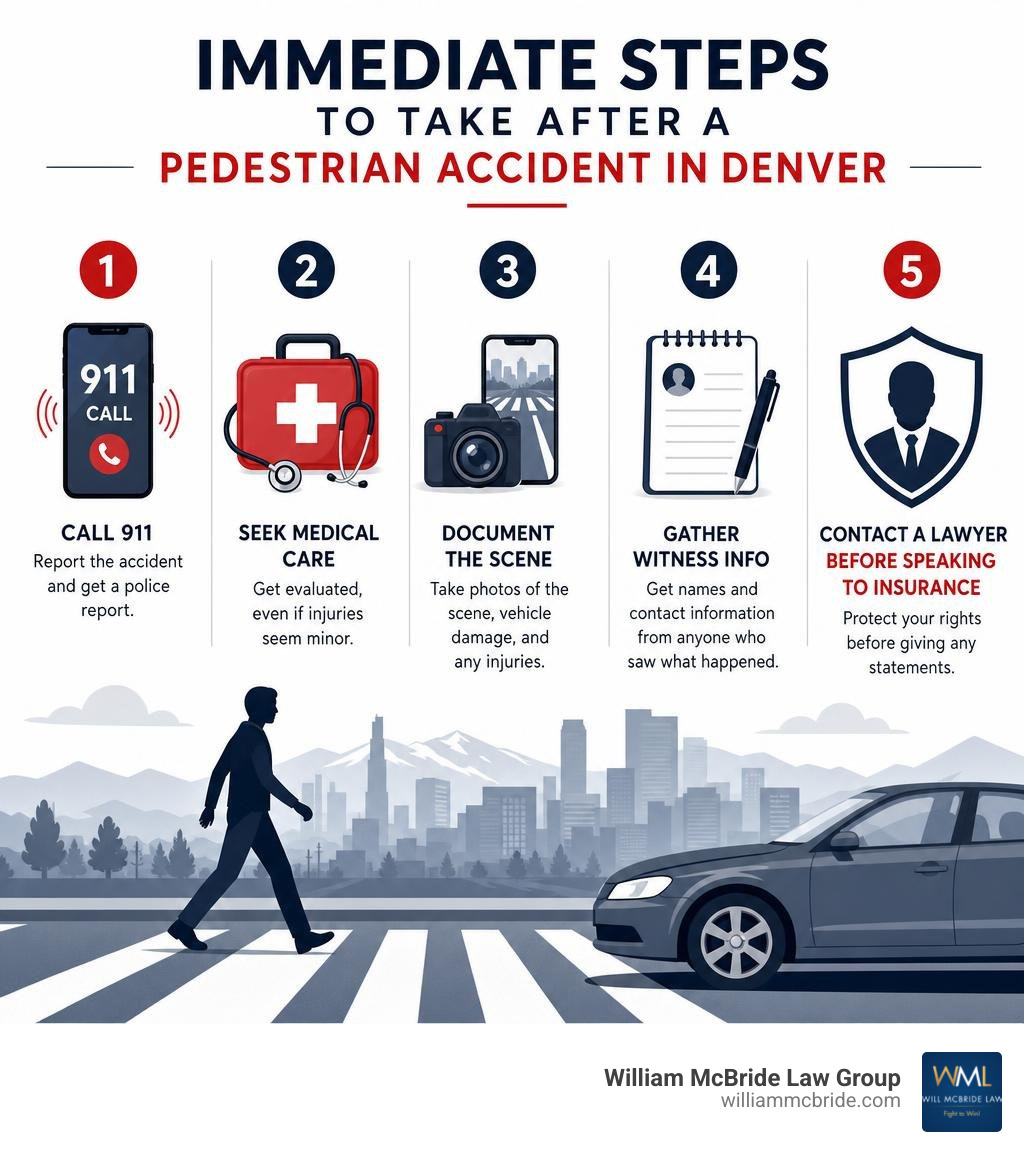
What you do in the minutes, hours, and days following a pedestrian accident can impact both your physical recovery and your legal rights. If you are hit by a vehicle, try to take these steps to protect yourself:
- Move to Safety: If you are physically able, carefully move out of the roadway to a sidewalk or shoulder to avoid being struck by other vehicles. Do not attempt to move if you suspect a serious neck, back, or spinal injury.
- Call 911 immediately: Request both emergency medical services and police assistance. Ensure that a formal police report is filed, as this is a crucial piece of evidence for your claim.
- Seek Immediate Medical Attention: Even if you feel fine or think your injuries are minor, go to an emergency room or urgent care center the same day. Adrenaline can mask severe internal injuries, brain trauma, or soft-tissue damage. Seeking prompt medical care also prevents insurance companies from claiming your injuries were not caused by the crash.
- Document the Scene: If you are able, use your phone to take photos of the vehicle that hit you, its license plate, the surrounding intersection, any traffic signals, skid marks, and your visible injuries.
- Gather Witness Contact Info: Ask any bystanders who stopped to help for their names, phone numbers, and email addresses. Their independent accounts of the crash can be invaluable.
- Avoid Speaking to Insurance Adjusters: Do not give a recorded statement, sign any medical releases, or accept an early settlement offer before consulting a lawyer.
- Contact a Lawyer: Reach out to an experienced attorney who handles auto accidents and pedestrian injuries as soon as possible to ensure that vital evidence is preserved.
Protecting Your Rights and Meeting Key Deadlines
In Colorado, you do not have unlimited time to pursue a legal claim. The state has strict statutes of limitations that dictate how long you have to file a lawsuit after an accident:
- Standard Motor Vehicle Accidents: If you were struck by a private passenger vehicle, Colorado law generally gives you three years from the date of the crash to file a personal injury lawsuit.
- Government-Owned Vehicles: If you were struck by a city bus, a police cruiser, or any other government-owned vehicle, the rules are much stricter. Under the Colorado Governmental Immunity Act (CGIA), you must file a formal Notice of Claim within 182 days of the accident. Failing to meet this short deadline will bar you from recovering any compensation.
- Wrongful Death Claims: If you are filing a claim on behalf of a loved one who passed away, the statute of limitations is generally two years from the date of their death.
Because these timelines are strict and the investigation process takes time, it is vital to consult with a lawyer as soon as possible. Missing a deadline means losing your right to hold the negligent party accountable forever.
Conclusion
A pedestrian accident can shatter your sense of safety and leave your family facing immense physical, emotional, and financial burdens. But you do not have to carry this weight alone.
Attorney Will McBride and the team at William McBride Law Group believe that every injured person deserves dignity, respect, and aggressive legal representation. We do not back down from insurance companies, and we are always prepared to take a case to court to ensure our clients receive a fair outcome. Whether you are dealing with a pedestrian crash, a car accident, or bicycle injuries, we are here to help you navigate the road to recovery.
If you or a loved one has been injured on Denver’s streets, contact us today to schedule your free, confidential case review. We will listen to your story, explain your legal options in plain English or Spanish, and help you take the next step forward with confidence. Se habla español.
Disclaimer: The information provided in this article is for general educational purposes only and does not constitute formal legal advice. Case outcomes depend entirely on the unique facts of each situation.