What to Know Before Hiring a Denver Motorcycle Accident Attorney
If you’ve been hurt in a crash and are searching for a Denver motorcycle accident attorney, here is what you need to know right away:
Quick Answer: What a Denver Motorcycle Accident Attorney Does for You
- Investigates the crash and preserves critical evidence before it disappears
- Handles all communication with insurance companies on your behalf
- Builds a case under Colorado’s modified comparative negligence rules
- Pursues compensation for medical bills, lost wages, pain and suffering, and more
- Files your lawsuit before Colorado’s three-year statute of limitations expires
- Prepares for trial if the insurance company refuses a fair settlement
CDOT’s numbers are sobering. In 2024, Colorado recorded a high of 165 motorcyclist deaths. Riders made up just 3% of vehicle registrations, yet nearly 24% of traffic fatalities. Though deaths fell to 147 in 2025, warmer late-year weather brought more riding days and a sharp rise in November and December fatalities.
After a serious crash, the physical and financial pressure can feel overwhelming. Medical bills stack up. Paychecks stop. And insurance companies — who often view riders as reckless thrill-seekers before a single fact is reviewed — begin working to protect their bottom line, not yours.
Attorney Will McBride, known in the community as Abogado William, believes every injured person deserves someone in their corner who takes the case seriously from day one. The checklist below is designed to help you choose the right legal advocate — someone who is prepared, communicative, and ready to fight when it matters.
Understanding the Unique Risks and Causes of Denver Motorcycle Crashes
Riding a motorcycle through the Denver metro area offers an unmatched sense of freedom, but it also exposes riders to significant vulnerabilities. Unlike occupants of passenger cars, motorcyclists lack the structural protection of a steel frame, seatbelts, and airbags. When a collision occurs, the physical impact is direct and often catastrophic.
A major portion of these collisions can be traced back to driver negligence. According to traffic safety data, some of the most common causes of motorcycle accidents in Denver include:
- Left-Turn Collisions: These are among the most dangerous scenarios. An oncoming passenger vehicle turns left at an intersection, directly into the path of an oncoming motorcycle. Drivers often fail to see the motorcycle or misjudge its speed.
- Distracted Driving: Drivers looking at mobile devices, adjusting navigation systems, or ignoring their surroundings frequently fail to notice smaller vehicles sharing the road.
- Lane Changes and Blind Spots: Due to a motorcycle’s smaller profile, drivers who fail to check their blind spots thoroughly before changing lanes can easily sideswipe a rider.
- Road Hazards and Weather: Potholes, loose gravel, uneven pavement, and sudden Colorado snow or rain can cause a rider to lose control, especially when other drivers follow too closely.
The statistics highlight a growing crisis on Colorado roads. Motorcycle fatalities in the state have risen 57% since 2015. Additionally, approximately 35% of all motorcycle accident fatalities occur at intersections, where driver inattention is most lethal according to Colorado Department of Transportation
When a passenger vehicle strikes a motorcyclist, the legal issues can be as complex as the injuries. In many cases, a motorcycle crash is handled differently than a standard Auto Accident Denver because of the severity of the injuries and the immediate need to secure physical evidence from the scene.
To navigate these challenges, riders benefit from understanding their rights under Colorado law and seeking dedicated legal support to protect their interests.
How Colorado Laws Affect Your Motorcycle Injury Claim
Colorado has specific statutes that directly impact how a motorcycle accident claim is evaluated, negotiated, and litigated. Understanding these rules is crucial for anyone seeking to recover damages after a crash.
Lane Splitting vs. Lane Filtering in Colorado
For many years, any form of riding between lanes of traffic was strictly prohibited in Colorado. However, the legal landscape updated recently under Colorado Senate Bill 24-079. It is vital for riders to understand the distinction between illegal lane splitting and legal lane filtering.
| Riding Maneuver | Legal Status in Colorado | Specific Conditions & Rules |
|---|---|---|
| Lane Splitting | Illegal | Riding between rows of moving or fast-flowing traffic in the same lane is prohibited. |
| Lane Filtering | Legal (Under SB 24-079) | Allowed only when traffic is completely stopped. Riders must travel at 15 mph or less, and the road must have lanes wide enough to pass safely. |
Modified Comparative Negligence (The 50% Bar)
Colorado operates under a modified comparative negligence system with a 50% bar. This means that an injured rider can recover damages as long as they are less than 50% at fault for the accident according to Legal Clarity What Is Colorado’s Modified Comparative Negligence Law?
However, the recovery amount is reduced by the rider’s percentage of fault. For example, if a jury determines that a rider suffered $100,000 in damages but was 20% at fault for speeding, the recovery is reduced to $80,000. If the rider is found to be 50% or more at fault, they are legally barred from recovering any compensation. Because insurance adjusters often try to shift blame onto the rider to trigger this rule, having a dedicated legal advocate is essential.
Helmet and Eye Protection Laws
In Colorado, riders and passengers aged 18 and older are not legally required to wear a helmet. However, helmets are mandatory for any operator or passenger under the age of 18.
Regardless of age, Colorado law requires all riders and passengers to wear eye protection, such as goggles, glasses with safety lenses, or a helmet equipped with a protective visor.
The Three-Year Statute of Limitations
Under Colorado Revised Statutes § 13-80-101, the statute of limitations for personal injury claims resulting from a motor vehicle accident is three years from the date of the crash. This is different from general personal injury cases, which often carry a two-year limit.
If you do not file a civil lawsuit within this three-year window, you lose your right to seek compensation through the court system. If a government entity was involved in the crash, such as a city-owned vehicle, you may also need to file a formal Notice of Claim within 182 days of the incident.
Because of these strict deadlines and complex liability rules, understanding the legal landscape is a key step in protecting your future. For a deeper look at why these laws require careful navigation, riders can read about Why You May Need a Car Accident Lawyer in Denver Colorado.
Riders who travel outside of Colorado should also note that laws vary significantly by state, with different jurisdictions operating under different regional rules, statutes of limitations, or comparative fault systems.
The Checklist: Selecting the Right Denver Motorcycle Accident Attorney
Finding the right attorney to represent you after a serious crash is a decision that can shape your physical and financial recovery. It is not just about finding someone who handles general personal injury cases; it is about finding an advocate who understands the specific dynamics of motorcycle riding.
When evaluating a Motorcycle Accident Lawyer in Denver, use the following checklist to guide your search:
- Specific Motorcycle Experience: Does the attorney regularly handle motorcycle accident claims? They should know how to counter common biases and understand motorcycle-specific physics.
- Trial Readiness: Is the firm prepared to take your case to court if the insurance company refuses to offer a fair settlement?
- Clear Fee Structure: Does the firm operate on a contingency fee basis? This means you pay nothing upfront, and the attorney only receives a percentage if they recover money for you, ensuring that legal representation remains accessible to those who need it most.
- Bilingual Accessibility: If Spanish is your preferred language, does the firm offer full bilingual support? Attorney Will McBride is known publicly as Abogado William and is dedicated to providing clear, accessible representation in both English and Spanish (Se habla español).
Seeking a Denver Motorcycle Accident Attorney with Trial Experience
Many personal injury cases are resolved through negotiations before a lawsuit is even filed. However, if an insurance company realizes that an attorney is unwilling to go to court, they have little incentive to offer a truly fair settlement.
A trial-ready firm prepares every case from day one as if it is headed to a jury. This level of preparation involves gathering physical evidence, interviewing witnesses, and consulting accident reconstruction professionals. When insurance adjusters see a meticulously documented case, they are much more likely to negotiate reasonably.
For those interested in how thorough preparation impacts outcomes, reviewing past Verdicts and Settlements can offer valuable context on the importance of litigation strength.
Evaluating a Denver Motorcycle Accident Attorney on Communication and Accessibility
A serious injury brings immense stress, and the last thing a client needs is to feel ignored by their legal team. Respectful representation means keeping the client informed at every step of the process.
When choosing an attorney, consider how easy it is to reach their office and whether they treat you as an individual rather than just another file. If you prefer to discuss your case in person, check if they have a local office where you can meet directly with the team. For those in the Denver area, you can easily reach out through the Contact Denver Office page to schedule a face-to-face discussion.
Overcoming Insurance Bias and Recovering Fair Compensation
One of the most frustrating challenges injured motorcyclists face is the built-in bias from insurance adjusters. There is a common, unfair stereotype that anyone who rides a motorcycle is inherently reckless.
When an accident occurs, insurance companies often try to use this bias to shift the blame onto the rider, arguing that the motorcyclist must have been speeding, lane-splitting illegally, or riding carelessly. Overcoming this bias requires clear, objective evidence, such as dashcam footage, eyewitness statements, and police reports.
When liability is established, an injured rider may pursue compensation for a variety of damages, including:
- Medical Expenses: This covers emergency room visits, surgeries, hospital stays, physical therapy, and any anticipated future medical care.
- Lost Income: If your injuries prevent you from working, you can seek compensation for lost wages, as well as diminished earning capacity if you can no longer return to the same line of work.
- Pain and Suffering: This compensates for the physical pain, emotional distress, and loss of enjoyment of life caused by the crash.
- Property Damage: This covers the cost of repairing or replacing your motorcycle, helmet, and riding gear.
The compensation pursued is often closely tied to the severity of the injuries sustained. Motorcyclists frequently suffer severe, life-altering conditions, such as:
- Traumatic Brain Injuries (TBI): Even when wearing a helmet, the force of a crash can cause concussions or severe cognitive impairments.
- Spinal Cord Injuries: Damage to the spine can lead to temporary or permanent paralysis, requiring lifetime medical support.
- Severe Road Rash: This is not a simple scrape. Severe road rash can damage multiple layers of skin, muscle, and nerves, often requiring skin grafts and leaving permanent scars.
- Fractures and Internal Damage: Broken bones, crushed limbs, and internal organ damage are common when a rider is thrown from their bike.
Understanding the long-term impact of these physical damages is critical to building a strong claim. You can read more about the medical and legal aspects of these conditions by visiting the Motorcycle Injuries resource page.
Frequently Asked Questions About Denver Motorcycle Accidents
How does not wearing a helmet affect my injury claim in Colorado?
Because Colorado law does not require riders aged 18 and older to wear a helmet, not wearing one does not prevent you from filing an injury claim. Furthermore, Colorado law generally prevents the defense from using the failure to wear a helmet as evidence to reduce your compensation or prove comparative fault.
However, wearing a DOT-approved helmet is highly recommended. Helmets are 37% effective in preventing fatal head injuries for operators and 41% effective for passengers. While not wearing a helmet may not legally bar your claim, wearing one can save your life and prevent catastrophic brain trauma.
What is the statute of limitations for a motorcycle crash in Colorado?
In Colorado, you have three years from the exact date of the motorcycle crash to file a personal injury lawsuit. If you are filing a wrongful death claim on behalf of a loved one who passed away in a crash, the timeline is generally two years from the date of death.
Because gathering evidence and negotiating with insurers takes time, it is highly advisable to contact an attorney well before these deadlines approach.
What should I do immediately after a motorcycle accident in Denver?
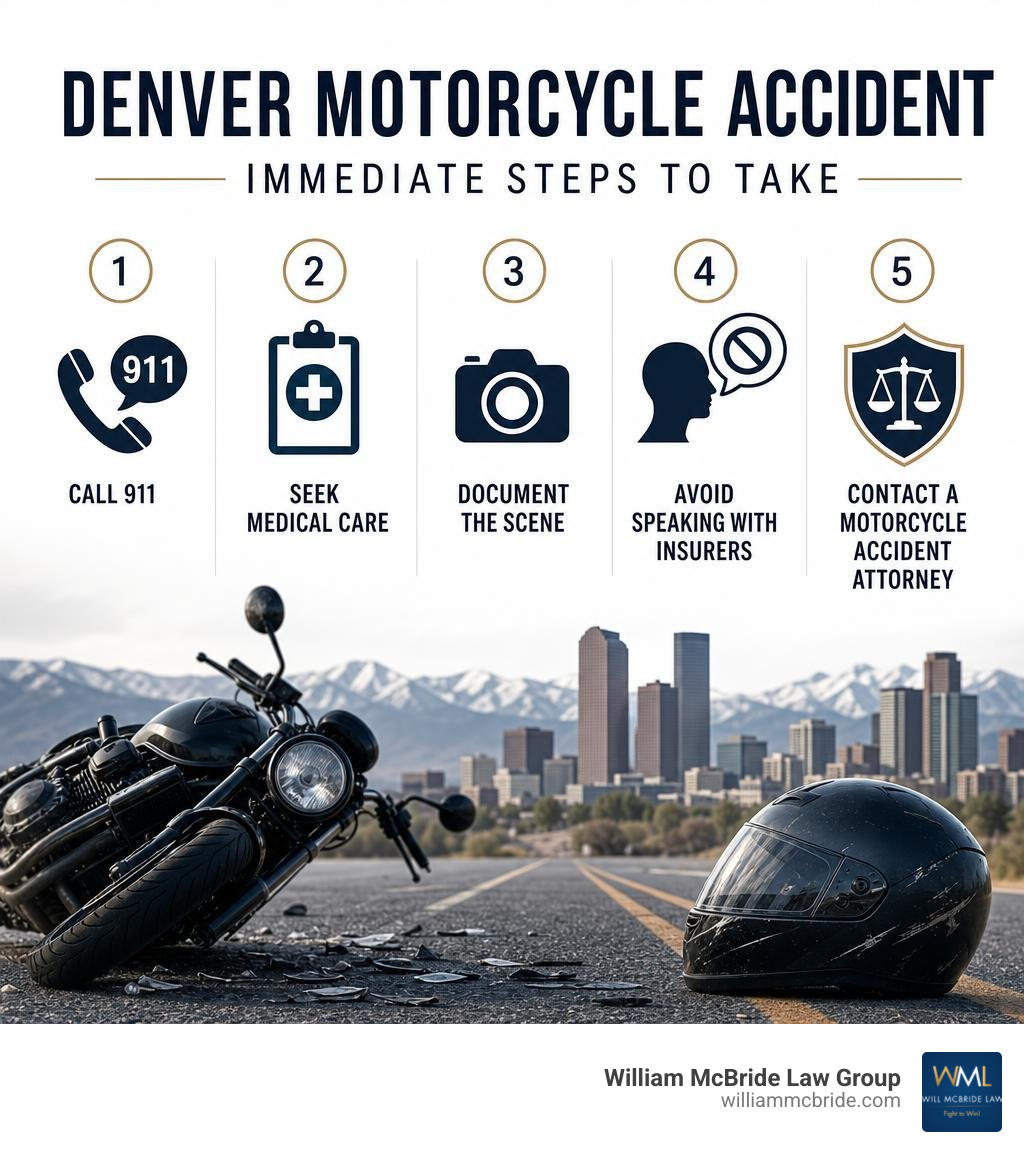
If you are involved in a crash, taking the following steps can protect both your physical health and your legal rights:
- Seek Medical Care: Your health is the absolute priority. Go to an emergency room or see a doctor immediately, even if you feel fine. Some serious injuries, like internal bleeding or concussions, do not show symptoms right away.
- Report the Crash: Call 911 so Denver police or emergency responders can document the scene and create an official police report.
- Preserve Evidence: Take photos of the road conditions, vehicle damage, and your injuries. Keep your damaged helmet, riding gear, and motorcycle in their post-crash state.
- Avoid Discussing Fault: Do not apologize or discuss liability with the other driver or their insurance adjuster.
- Consult an Attorney: Speak with a legal professional before signing any documents or accepting quick settlement offers from an insurance company.
For Spanish-speaking riders, having access to legal assistance in your native language is vital during this stressful time. You can learn more about finding bilingual support by visiting the Abogado de Accidentes de Motocicleta en Denver page.
Conclusion
Recovering from a motorcycle accident is a physical, emotional, and financial challenge. While a fair settlement is often the most efficient path forward, true fairness only comes from careful preparation, solid evidence, and a legal team that is ready to stand up to insurance companies.
William McBride Law Group is committed to helping injured riders navigate the complex legal system with dignity and respect. Attorney Will McBride and his team approach every case with a trial-ready focus, ensuring that your side of the story is protected from the very beginning.
If you or a loved one is dealing with the aftermath of a crash, you do not have to handle the burden alone. To see how the firm has supported others in similar situations, you can review some of our past Results.
When you are ready to discuss your options and make an informed decision about your recovery, we invite you to contact us for a free, confidential case review. You can also explore our detailed guide on Motorcycle Injuries to learn more about protecting your rights.
Disclaimer: The information provided in this article is for general educational purposes only and does not constitute formal legal advice. Case outcomes depend entirely on the specific facts of each individual situation.