
When Every Minute Counts: Finding a Car Accident Attorney in Denver, Colorado
If you need a car accident attorney in Denver, Colorado, here is what matters most right away:
Quick answers for accident victims in Denver:
- Seek medical care first — even if you feel fine. Some injuries appear hours or days later.
- Call 911 and get a police report number before leaving the scene.
- Document everything — photos, witness names, insurance details.
- Do not give a recorded statement to any insurance company before speaking to an attorney.
- You have three years to file a car accident lawsuit in Colorado (C.R.S. § 13-80-101) — but acting sooner protects critical evidence.
- A free consultation costs nothing — and represented victims recover significantly more on average.
A crash can change everything in seconds. One moment you are driving through Denver traffic. The next, you are dealing with pain, a damaged vehicle, missed work, and a stack of medical bills you did not ask for.
Then the phone rings. It is the other driver’s insurance company — and they are asking questions.
That is the moment when fear, pain, and uncertainty can turn into costly mistakes — unless you have the right legal support protecting you.
Denver County recorded over 15,000 car accidents in a single recent year. Serious injuries are common. Financial stress follows quickly. And insurance companies move fast — often before injured people have had time to fully understand what happened to them.
The good news: Colorado law gives accident victims real rights and real options. But protecting those rights takes action, documentation, and in most cases, legal guidance from someone who knows how the process works.
Will McBride believes that every person injured in a crash deserves to be treated with respect, to understand their options clearly, and to have someone genuinely fighting for their recovery. We serve clients in English and Spanish. Se habla español.
This guide walks through everything a Denver accident victim needs to know — from the first 72 hours after a crash to understanding Colorado’s fault laws, compensation options, and how to find the right legal representation.

Immediate Steps to Take After a Denver Car Crash
The moments following a car collision are often chaotic. Adrenaline runs high, and clear thinking can be difficult. However, the steps taken immediately after an accident play a vital role in protecting both physical health and any future legal claim.
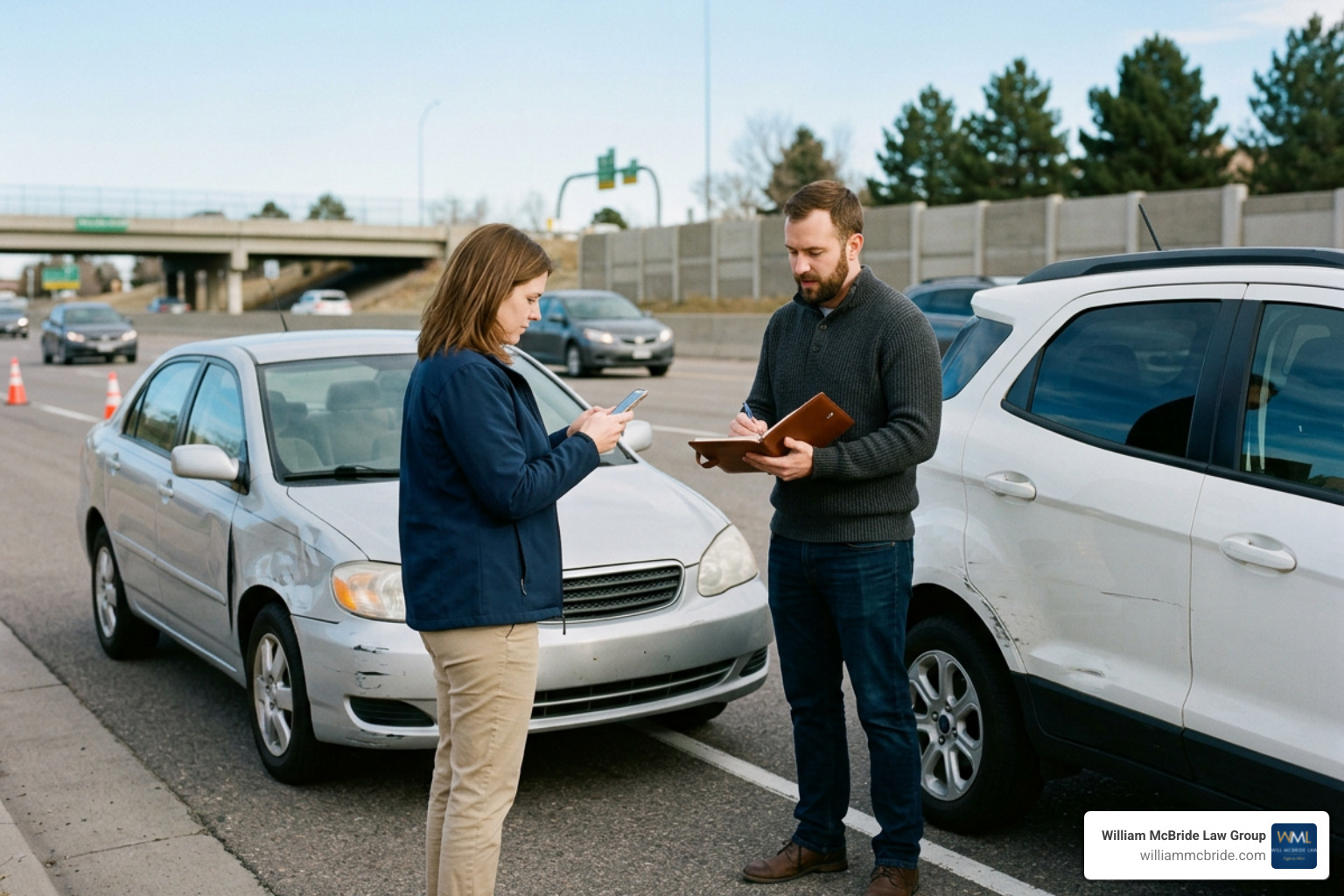
1. Prioritize Safety and Check for Injuries
Immediately move vehicles out of the flow of traffic if possible and safe to do so. Turn on hazard lights. Check yourself, your passengers, and the occupants of the other vehicles for injuries.
2. Call 911
Always contact law enforcement to report the accident. A formal police report provides an objective, third-party record of the crash. When police arrive, stick to the facts of what happened. Avoid guessing or speculating. Make sure to obtain the officer’s name, badge number, and the incident report number.
3. Seek a Medical Evaluation
Even if there are no obvious wounds, see a healthcare provider within 24 hours. Severe conditions like whiplash, internal bleeding, and mild traumatic brain injuries may not show symptoms immediately due to the shock and adrenaline of the event. Having a documented medical evaluation right after the crash establishes a direct link between the accident and the injuries.
For those seeking professional assistance, understanding the recovery process is key. You can find More info about auto accident services in Denver to guide you through the initial steps. Additionally, bilingual families can access dedicated Spanish-language support for auto accidents to ensure they fully understand their rights.
4. Preserve Evidence at the Scene
If it is safe to do so, document the scene thoroughly:
- Take clear photos and videos of all vehicle damage, license plates, road conditions, skid marks, traffic signals, and any visible physical injuries.
- Collect contact details, driver’s license numbers, and insurance information from all drivers involved.
- Gather names and phone numbers of any witnesses who saw the collision occur.
5. Avoid Admitting Fault or Apologizing
It is natural to want to say “I’m sorry” out of politeness or shock. However, in the legal and insurance worlds, an apology can be construed as an admission of fault. State only the facts to the responding officers and the other parties.
6. Exercise Caution on Social Media
Do not post about the accident, your injuries, or your recovery on social media. Insurance adjusters regularly monitor public profiles looking for posts or photos that they can use to downplay the severity of your injuries or dispute liability.
Understanding Colorado Car Accident Laws and Fault
Colorado operates under an “at-fault” auto insurance system. This means the driver who caused the accident is financially responsible for the resulting damages. To recover compensation, an injured victim must establish that the other party’s negligence caused the crash.
Determining recovery in Colorado is heavily influenced by the state’s comparative negligence laws.
| Fault System | How It Works | Impact on Compensation |
|---|---|---|
| Modified Comparative Negligence (Colorado Rule – C.R.S. § 13-21-111) | You can recover damages as long as your fault is under 50%. | Your final compensation is reduced by your exact percentage of fault. |
| Pure Comparative Fault (Used in some other states) | You can recover damages even if you are 99% at fault. | Your compensation is reduced by your percentage of fault, regardless of how high it is. |
Under Colorado’s modified comparative negligence rule (C.R.S. § 13-21-111), if an injured party is found to be 20% responsible for a collision, their final compensation will be reduced by 20%. However, if their responsibility reaches or exceeds 50%, they are legally barred from recovering any compensation from the other driver.
Critical Legal Deadlines (Statute of Limitations)
In Colorado, the timeline for filing a lawsuit is strictly governed by state law. Under C.R.S. § 13-80-101, injured victims generally have three years from the date of the car accident to file a personal injury lawsuit.
While three years may seem like a long time, waiting can be highly detrimental. Over time, physical evidence disappears, traffic camera footage is overwritten, and witness memories fade. If a government vehicle was involved in the crash, the deadline to file a formal notice of claim is significantly shorter—often just 182 days.
Understanding these detailed laws can be overwhelming, which is why seeking legal guidance early is so important. Read More info about why you may need a Denver lawyer to see how local regulations affect your specific situation.
Proving Fault in Denver Crashes
Establishing liability requires gathering solid evidence. A skilled attorney will analyze multiple sources to build a strong case:
- Police Reports: Officers’ notes, citations issued, and initial determinations of fault.
- Traffic Camera Footage: Video captured by city traffic cameras or nearby business security systems.
- Distracted Driving Statistics: Distracted driving, such as texting, accounts for roughly 15% of motor vehicle accidents in Colorado.
- Impaired Driving Data: Close to 27% of all car accidents in Colorado involve drunk or impaired drivers.
- Intersection Analysis: Approximately 50% of all car accidents occur at intersections, often due to failure to yield or running red lights.
When to Contact a Car Accident Attorney in Denver Colorado
Many accident victims wonder if they truly need to hire a car accident attorney in Denver, Colorado, or if they can manage the insurance claim on their own. While simple property damage claims can sometimes be resolved independently, cases involving physical injuries almost always benefit from legal representation.
Navigating Insurance Company Tactics
Insurance companies are businesses focused on protecting their bottom lines. Soon after a crash, an adjuster may call asking for a recorded statement or offering a quick, lowball settlement.
Giving a recorded statement without legal guidance is highly risky. Adjusters are trained to ask questions in ways that can lead victims to inadvertently downplay their injuries or accept partial blame. Additionally, accepting an early settlement offer usually requires signing a release that prevents you from seeking further compensation if your injuries turn out to be more severe or require long-term care.
The Value of Legal Representation
Studies consistently highlight the advantages of having legal counsel:
- Personal injury victims represented by an attorney receive, on average, 3.5 times more in settlement compensation than those who handle claims on their own.
- Approximately 85% of legally represented personal injury plaintiffs succeed in obtaining a favorable settlement.
For accidents involving other types of vehicles, specialized legal knowledge is crucial. If you or a loved one were riding, you can find More info about motorcycle accidents or access Spanish motorcycle accident services. If the crash involved a commercial vehicle, explore More info about truck accidents and Spanish truck accident services to learn how federal trucking regulations impact your claim.
How a Car Accident Attorney in Denver Colorado Protects Your Rights
A dedicated attorney takes the administrative and legal burdens off your shoulders so you can focus on healing. Key responsibilities handled by a legal team include:
- Comprehensive Investigation: Gathering police reports, medical records, dashcam footage, and business surveillance video.
- Expert Consultation: Working with accident reconstructionists and medical specialists to prove how the crash occurred and the extent of your injuries.
- Handling Communication: Managing all phone calls, emails, and negotiations with insurance representatives so you do not have to.
- Identifying Vehicle Defects: In some cases, accidents are caused by mechanical failures. Learn More info about auto defects to see if a manufacturer might be liable.
- Documenting Injuries: Properly linking medical diagnoses to the crash. For detailed guidance, review More info about auto related injuries, which covers common conditions such as:
- Whiplash and Soft Tissue Damage: Neck and back strain that can cause chronic pain.
- Traumatic Brain Injuries (TBIs): Concussions and cognitive impairments resulting from sudden physical impact.
- Spinal Cord Damage: Herniated discs or paralysis requiring long-term medical care.
What Does It Cost to Hire a Car Accident Attorney in Denver Colorado?
One of the most common reasons people hesitate to contact an attorney is the fear of high legal fees. However, personal injury attorneys typically operate on a contingency fee structure.
Under this arrangement:
- There are no upfront, out-of-pocket costs to hire an attorney.
- The law firm covers all initial case expenses, such as filing fees, expert witness costs, and medical record retrieval.
- Legal fees are paid only if the attorney successfully secures a settlement or court verdict on your behalf.
- The attorney’s fee is a mutually agreed-upon percentage of the final recovery. If no compensation is recovered, you owe no attorney fees.
This structure ensures that high-quality legal representation is accessible to everyone, regardless of their immediate financial situation.
Damages and Compensation in Denver Car Accident Claims
When negligence causes a crash, the injured party has the right to seek financial compensation—referred to as “damages”—for their losses. These damages are divided into distinct categories under Colorado law.
1. Economic Damages
These represent the direct, measurable financial losses resulting from the accident:
- Medical Expenses: Emergency room visits, hospital stays, surgeries, physical therapy, prescription medications, and anticipated future medical care.
- Lost Wages: Income lost due to missed work during recovery.
- Loss of Earning Capacity: If injuries prevent a victim from returning to their previous line of work or working full-time in the future.
- Property Damage: Costs to repair or replace your vehicle and any personal items damaged in the crash.
2. Non-Economic Damages
These address the subjective, non-financial impacts of an injury on a person’s life:
- Pain and Suffering: Physical discomfort and agony endured due to the injuries.
- Emotional Distress: Anxiety, depression, sleep disturbances, or PTSD caused by the trauma of the collision.
- Loss of Enjoyment of Life: The inability to participate in hobbies, sports, or family activities that you enjoyed before the crash.
Colorado places statutory caps on non-economic damages, which are periodically adjusted for inflation. An experienced attorney can explain how these caps apply to your specific situation.
3. Wrongful Death Damages
If a collision results in a tragic loss of life, surviving family members may seek compensation for funeral costs, medical bills incurred before death, and loss of financial support and companionship. To understand the legal options available during such a difficult time, read More info about wrongful death claims.
4. Punitive Damages
In rare cases involving extreme recklessness or willful misconduct—such as severe drunk driving or street racing—the court may award punitive damages. These are intended to punish the wrongdoer and deter others from similar behavior.
Frequently Asked Questions About Denver Car Accidents
Dealing with the aftermath of an accident brings many questions. Below are straightforward answers to common concerns.
How long does a car accident lawsuit take in Denver, Colorado?
The duration of a car accident claim varies significantly based on the details of the case. A straightforward claim with clear liability and minor injuries may resolve within a few months.
However, more complex cases can take a year or longer. Key factors influencing the timeline include:
- Duration of Medical Treatment: It is critical to reach Maximum Medical Improvement (MMI) before settling. This ensures all current and future medical costs are fully accounted for.
- Negotiation Process: Settlement negotiations with insurance companies can take several rounds of proposals and counterproposals.
- Litigation and Court Schedules: If a fair settlement cannot be reached and a lawsuit must be filed, the timeline will depend heavily on the court’s calendar and trial preparation steps.
What if the other driver is uninsured or underinsured in Colorado?
Despite legal requirements, many drivers on Colorado roads operate vehicles without liability insurance or carry only the state-mandated minimums ($25,000 per person for bodily injury).
If you are hit by an uninsured or underinsured driver, your primary source of recovery will likely be your own auto insurance policy:
- Uninsured/Underinsured Motorist (UM/UIM) Coverage: Under C.R.S. § 10-4-609, insurance companies in Colorado must offer UM/UIM coverage unless you reject it in writing. This coverage steps in to pay for your medical bills and lost wages when the at-fault driver lacks sufficient insurance.
- Medical Payments (MedPay) Coverage: This optional coverage pays for immediate medical expenses regardless of who caused the crash.
For guidance tailored to your situation, speak directly with Will McBride about your Denver auto accident claim and next steps.
Can I still recover compensation if I was partially at fault?
Yes. As discussed under Colorado’s modified comparative negligence rules, you can still recover compensation as long as your share of responsibility for the crash is less than 50%.
Your final compensation will be reduced by your percentage of fault. For example, if your total damages are $100,000 and you are found to be 10% at fault, you can recover $90,000. Because insurance adjusters often try to assign a higher percentage of fault to victims to reduce payouts, having an advocate to protect your side of the story is highly beneficial.
Conclusion
A car accident can disrupt your life, leaving you with physical pain, emotional stress, and financial uncertainty. You do not have to navigate this challenging road alone.
Our dedicated legal team is committed to helping injured individuals and their families find stability and justice. With an aggressive trial-ready approach and a deep commitment to treating every client with dignity, the firm stands ready to hold negligent parties accountable.
We provide compassionate, clear, and bilingual legal support in both English and Spanish (Se habla español). If you or a loved one has been injured, please Contact our Denver office for a free, confidential case review, or Learn more about our auto accident representation to understand how we can protect your rights and help you move forward.
Disclaimer: The information provided in this article is for general educational purposes only and does not constitute formal legal advice. Case outcomes depend entirely on the unique facts and circumstances of each individual situation.