
When a Car Crash in Denver Changes Everything
If you’re looking for a car accident attorney in Denver, Colorado, here is what you need to know right away:
- Call 911 and get a police report filed at the scene
- Seek medical care immediately, even if you feel fine — symptoms can appear days later
- Do not give a recorded statement to any insurance adjuster before speaking with an attorney
- You have 3 years from the date of the crash to file a personal injury lawsuit under Colorado law (C.R.S. § 13-80-101)
- You can still recover compensation even if you were partly at fault, as long as your share of fault is under 50%
- Most car accident attorneys work on contingency — no fee unless you recover
A serious car accident doesn’t just damage your vehicle. It can upend your entire life in a matter of seconds — leaving you with medical bills you didn’t plan for, income you can no longer earn, and questions that no one seems willing to answer clearly.
For working families in Denver, that uncertainty is real and heavy. The other driver’s insurance company has adjusters and attorneys working quickly to protect their interests. Studies suggest that injury victims who work with an attorney recover up to three times more than those who handle claims alone.
Attorney Will McBride understands that behind every case file is a real person dealing with pain, stress, and an uncertain road ahead. The goal of this guide is simple: help you understand your rights, your options, and the steps that matter most after a crash in Denver.
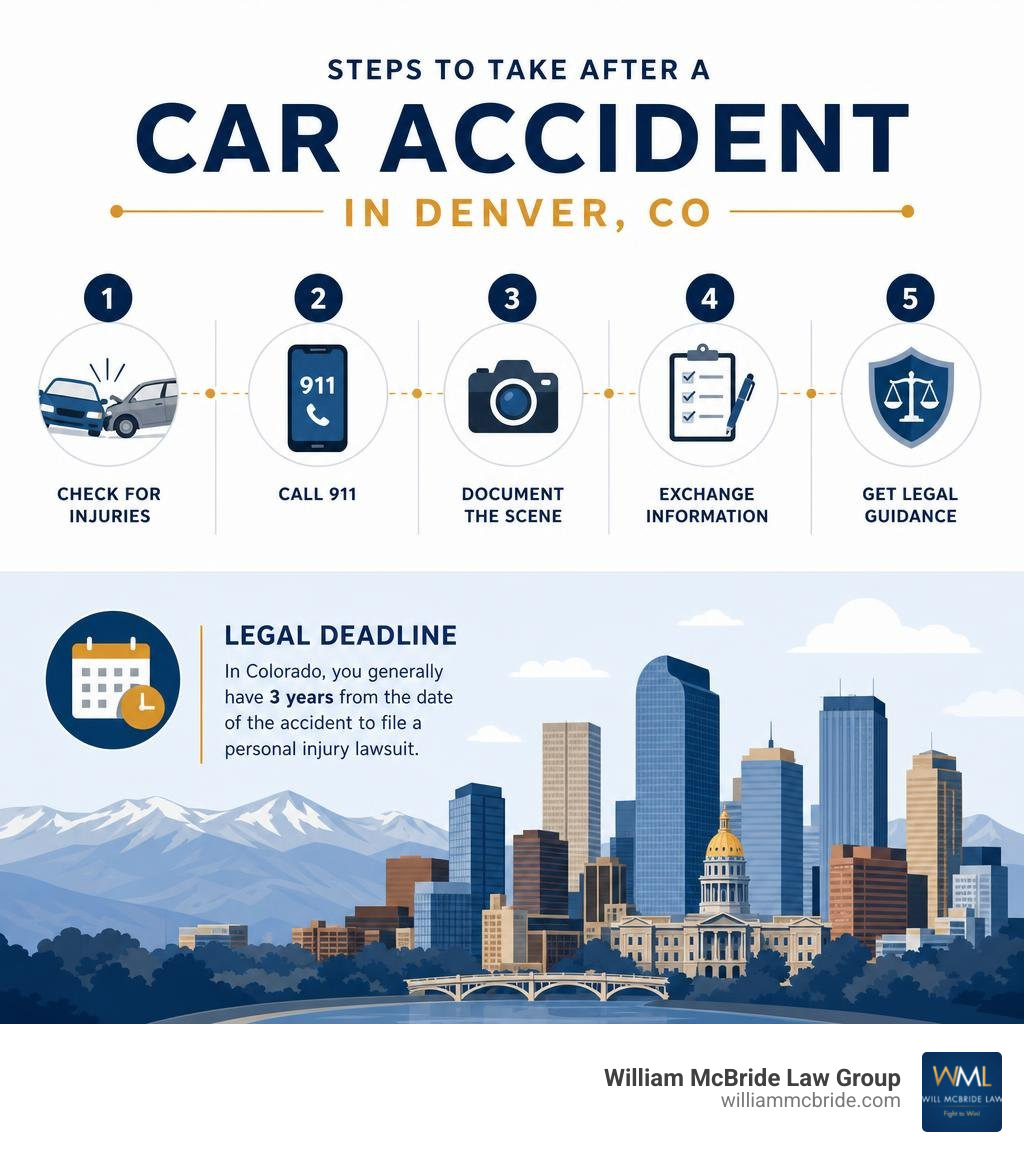
Immediate Steps to Take After a Car Crash in Denver
The moments following an auto accident are often chaotic. Your adrenaline is pumping, you may be in physical pain, and your mind is likely racing. However, what you do in the minutes and hours after a collision can profoundly affect both your physical recovery and your ability to seek financial compensation later.
In Denver, the local authorities responsible for responding to accidents are typically the Denver Police Department or, if the accident occurs in a surrounding jurisdiction, the appropriate local law enforcement agency. Getting law enforcement to the scene is critical. Even if the other driver asks you not to call the police, you should always make the call. A formal accident report serves as an objective, third-party record of what occurred.
Prioritizing Safety and Medical Care
Your absolute priority must be safety and health. If possible, move your vehicle to a safe spot out of the flow of traffic, turn on your hazard lights, and check yourself and your passengers for injuries.
Even if you do not feel immediate pain, seeking a professional medical evaluation is vital. Many common injuries, such as whiplash, soft tissue damage, internal bleeding, and traumatic brain injuries (TBIs), may not present noticeable symptoms right away. The adrenaline masking your pain can fade hours or days later, leaving you with severe discomfort.
From a legal perspective, waiting to seek medical care can severely damage your claim. Insurance adjusters look for any reason to undervalue your case, and a gap in treatment allows them to argue that your injuries were not caused by the crash or are not as serious as you claim. Establishing immediate medical records connects your physical condition directly to the accident. If you need more information about how different crashes impact your body, you can read about Auto Accidents.
Gathering Crucial Evidence at the Scene
If you are physically able to do so without putting yourself in danger, you should begin gathering evidence immediately at the crash site. This real-time documentation is incredibly difficult to replicate later.
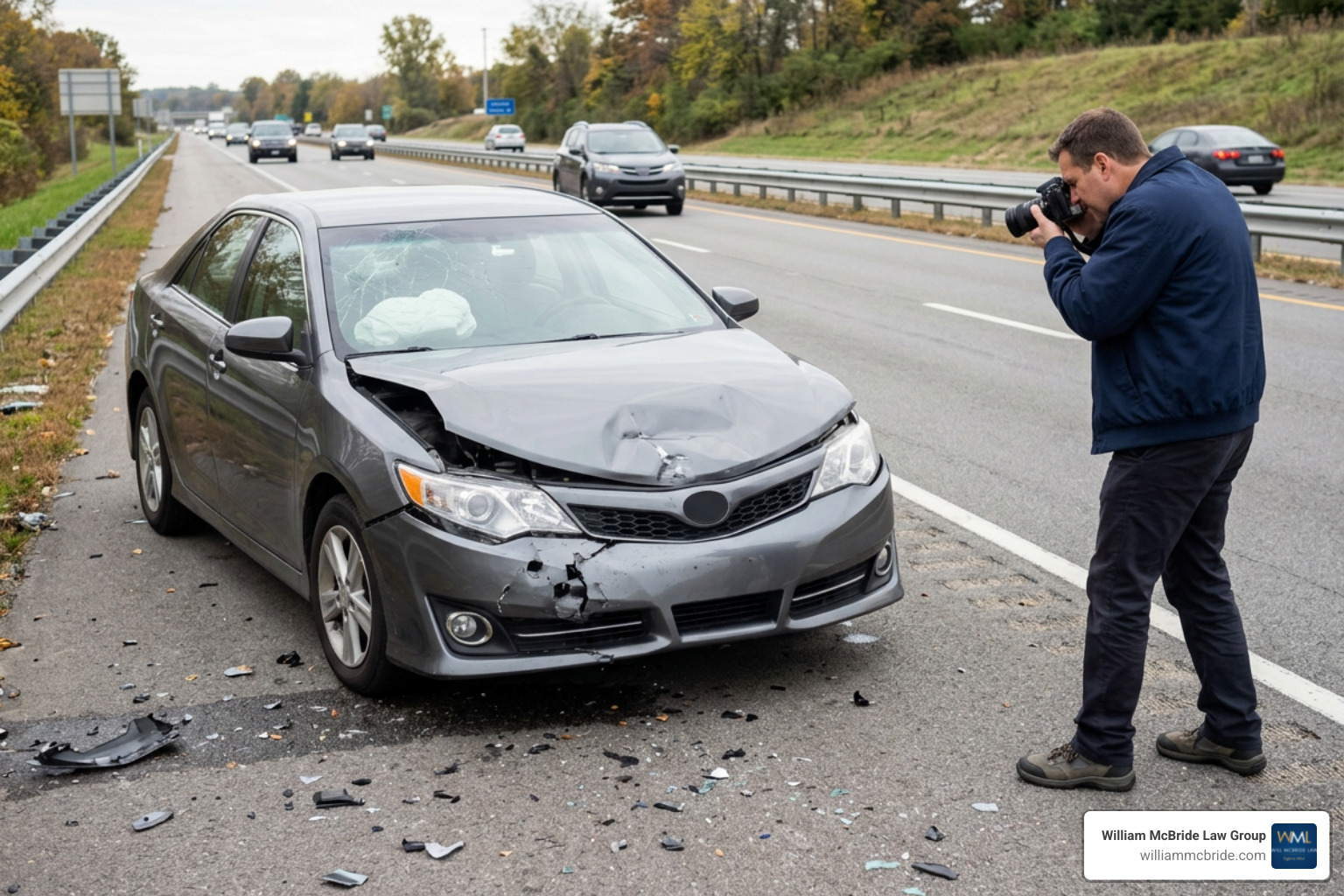
- Photo and Video Documentation: Take clear, wide-angle and close-up photos of all vehicles involved, the damage to each car, the position of the vehicles on the road, skid marks, road conditions, traffic signs, and any visible injuries.
- Witness Contact Information: If anyone stopped to help or witnessed the crash, ask for their names, phone numbers, and email addresses. Neutral witness testimony can be incredibly powerful if liability is disputed.
- Exchange Information: Get the other driver’s name, contact details, driver’s license number, license plate, and insurance policy details. Keep your conversation brief and factual; do not argue about who caused the crash.
- Dashcam Footage: If you or any witnesses have a dashcam, preserve the footage immediately before it is overwritten.
Once law enforcement arrives, cooperate fully and stick strictly to the facts. Do not apologize or say things like “I’m sorry, I didn’t see you,” as these statements can be construed as an admission of fault. Note the officer’s name, badge number, and ask how you can obtain a copy of the official police report once it is finalized.
Understanding Colorado’s Auto Insurance and Fault Laws
Colorado operates under an “at-fault” insurance system. This means that the driver who caused the motor vehicle accident is legally responsible for the resulting damages, including medical bills, property damage, lost wages, and non-economic losses like pain and suffering.
To recover compensation, you must prove that the other driver was negligent. In legal terms, this means establishing that they owed you a duty of care, breached that duty (by speeding, texting, running a red light, etc.), and that this breach directly caused your injuries and financial losses.
How Modified Comparative Negligence Affects Your Claim
It is not uncommon for insurance companies to argue that you share some portion of the blame for the accident. Under Colorado’s modified comparative negligence rule, you can still recover damages as long as your percentage of fault is less than 50 percent (known as the 50 percent bar rule).
However, your financial recovery will be reduced by your percentage of fault. If you are found to be 50 percent or more responsible for the collision, you are legally barred from recovering any compensation from the other party.
| Your Percentage of Fault | Total Determined Damages | Your Recoverable Compensation |
|---|---|---|
| 0% | $100,000 | $100,000 (Full recovery) |
| 10% | $100,000 | $90,000 (Reduced by 10%) |
| 30% | $100,000 | $70,000 (Reduced by 30%) |
| 50% or more | $100,000 | $0 (Barred from recovery) |
Because of these rules, insurance adjusters will actively look for ways to shift even a small percentage of fault onto you. Working with an experienced advocate like Attorney Will McBride helps ensure that your side of the story is supported by clear evidence, preventing insurers from unfairly inflating your share of liability.
Colorado Minimum Insurance Requirements and UM/UIM Coverage
Colorado law mandates that all registered vehicle owners carry minimum liability insurance coverages. These limits are designed to provide a baseline of financial protection, though they are often insufficient for serious injuries:
- $25,000 for bodily injury or death of a single person in an accident.
- $50,000 for total bodily injury or death of all people injured in a single accident.
- $15,000 for property damage per accident.
If you are hit by a driver who carries only the state-minimum limits, or someone who has no insurance at all, you could find yourself facing massive financial gaps. This is where Uninsured/Underinsured Motorist (UM/UIM) coverage becomes essential.
Colorado law requires insurance companies to offer UM/UIM coverage on all auto policies unless the policyholder rejects it in writing. If you have this coverage, your own insurance policy can step in to cover your medical costs and lost wages up to your policy limits if the at-fault driver is uninsured or lacks enough liability coverage to pay for your damages.
Why You Need a Car Accident Attorney Denver Colorado
Navigating the aftermath of a collision while trying to heal is exhausting. Dealing with aggressive insurance adjusters who want to close your file as cheaply as possible only adds to that stress. Having a dedicated car accident attorney in Denver, Colorado protect your rights allows you to focus entirely on your physical recovery.
How Insurance Companies Undervalue Your Claim
Insurance companies are businesses, and their primary goal is to protect their bottom line. They employ various tactics to undervalue or deny legitimate injury claims:
- Immediate Lowball Offers: An adjuster may call you within days of the accident, offering a quick cash settlement. While this money may seem helpful, accepting it requires you to sign a release waiving your right to seek any future compensation. If your injuries require surgery or long-term therapy down the road, you will have to pay for those costs out of pocket.
- Recorded Statements: Adjusters often ask for a recorded statement, framing it as a routine administrative step. In reality, they may ask leading questions designed to get you to downplay your injuries or admit to partial fault.
- Pre-Existing Conditions: If you have ever had a prior injury, the insurance company may try to argue that your current pain is entirely due to that pre-existing condition rather than the car crash.
Having legal representation stops these tactics in their tracks. Attorney Will McBride and his team take over all communication with the insurance companies, ensuring they cannot pressure you into an unfair settlement. For a deeper look at why legal help is so critical, you can read about Why You May Need a Car Accident Lawyer in Denver, Colorado.
When to Hire a Car Accident Attorney Denver Colorado vs. Handling It Alone
If your accident was a minor fender-bender with no physical injuries and minimal property damage, you may be able to handle the claim directly with the insurance company. However, you should strongly consider hiring an attorney if your case involves:
- Moderate to Severe Injuries: Any injury that requires emergency care, hospitalization, surgery, physical therapy, or results in missed work.
- Disputed Fault: When the other driver or their insurer claims you caused the crash, or when liability is complex, such as in a Multiple Car Pile Up.
- Commercial Vehicles: Accidents involving semi-trucks, delivery vans, or government vehicles, which often involve multiple layers of insurance and complex federal regulations.
- Uncooperative Insurers: When the insurance company delays your claim, refuses to negotiate in good faith, or issues a flat denial.
Securing legal advocacy early on provides peace of mind and ensures that critical evidence is preserved before it disappears. If you are located closer to the metro area, you can also explore options for an Auto Accident Denver.
Calculating the True Value of Your Personal Injury Claim
Determining what your car accident claim is worth is not a matter of plugging numbers into a generic online calculator. Every claim is unique, and its valuation depends heavily on the severity of your injuries, the clarity of fault, the available insurance policy limits, and how your day-to-day life has been impacted.
Economic vs. Non-Economic Damages
In Colorado, an injured victim can pursue compensation for both economic and non-economic damages:
- Economic Damages: These are tangible financial losses that can be documented with receipts, bills, and pay stubs. They include past and future medical bills, rehabilitative therapy, prescription costs, lost wages, loss of earning capacity (if you can no longer work at the same capacity), and property damage.
- Non-Economic Damages: These represent intangible losses that affect your quality of life. They include physical pain and suffering, emotional distress, and mental anguish. In tragic cases where an accident leads to a loss of life, families may seek compensation through a Wrongful Death Auto claim.
To establish the true value of your claim, your legal team will wait until you reach Maximum Medical Improvement (MMI) — the point at which your doctors believe your condition has stabilized as much as it is going to. Settling before reaching MMI is risky, as it is impossible to know what your future medical needs and costs will be.
The Statute of Limitations for Colorado Auto Accidents
You do not have unlimited time to take legal action after a crash. In Colorado, the statute of limitations establishes strict filing deadlines:
- Motor Vehicle Accidents: Under C.R.S. § 13-80-101, you generally have three years from the date of the accident to file a personal injury lawsuit. This is an extension of the standard two-year limit applied to other general personal injury claims.
- Government Claims: If your crash involved a government vehicle (such as a city bus, school bus, or municipal utility truck), you must file a formal notice of claim within 180 days under the Colorado Governmental Immunity Act.
If you miss these deadlines, the court will almost certainly dismiss your case, and you will lose your right to pursue compensation forever. Acting quickly allows your attorney to investigate the crash, gather fresh evidence, and build a strong foundation for your case.
Frequently Asked Questions About Denver Car Accidents
How does a contingency fee work for a car accident attorney Denver, Colorado?
Most personal injury attorneys, including the team at William McBride Law Group, operate on a contingency fee basis. This means there are no upfront, out-of-pocket attorney fees for you to hire a lawyer.
The attorney’s fees are paid as a percentage of the final settlement or court verdict obtained on your behalf. If your attorney does not win your case, you do not pay any legal fees. This structure ensures that high-quality legal representation is accessible to everyone, regardless of their financial situation. During your free consultation, the fee structure and any potential case expenses will be explained clearly so there are no surprises.
What are the most common causes of traffic accidents in Denver?
According to crash data and law enforcement reports, the vast majority of traffic collisions in the Denver area are caused by preventable driver behaviors. Some of the leading causes include:
- Careless and Distracted Driving: Distracted driving, such as texting, adjusting navigation, or eating behind the wheel, remains a leading cause of collisions.
- Failure to Yield: This behavior often causes crashes at busy intersections, especially when drivers misjudge traffic gaps or ignore traffic signals.
- Following Too Closely: Tailgating often leads to rear-end collisions, particularly during sudden stops on major corridors.
- Impaired Driving: Driving under the influence of alcohol or drugs remains a major contributor to severe and fatal accidents. If you were hit by an impaired motorist, you can learn more about your options regarding Drunk Drivers.
What if a government vehicle or agency caused my accident?
If your collision was caused by a government employee driving a public vehicle — such as a public transit bus, city maintenance truck, or state-owned vehicle — unique legal rules apply.
Under the Colorado Governmental Immunity Act, you must submit a written notice of your claim to the appropriate government entity within 180 days of the accident. This notice must contain specific details about the crash, your injuries, and the damages you are seeking. Failing to meet this strict 180-day deadline, or failing to follow the precise administrative procedures required, will result in the immediate loss of your right to sue the government agency.
Conclusion: Partnering with a Dedicated Advocate for Your Recovery
Recovering from a car accident is a physical, emotional, and financial journey. You should not have to navigate the complex legal landscape alone while trying to heal.

Attorney Will McBride and the William McBride Law Group are committed to standing up for working families who have been harmed by negligence. Known publicly as Abogado William, he brings a community-rooted, trial-ready approach to every case. The firm is proud to offer bilingual legal help — Se habla español — ensuring that all members of our community have equal access to clear, compassionate, and powerful legal representation.
Whether your accident occurred on I-25, near I-70, or in a local neighborhood, we are here to listen to your story, explain your options, and help you move forward with confidence. If you also have family or legal matters in other regions, we maintain office locations in Denver, CO, Albuquerque, NM, and Orlando, FL, and can assist with related accident claims.
Anyone injured in a serious accident should not have to guess about their next step. Attorney Will McBride offers free case reviews to help you understand your options and make informed decisions. To take the first step toward reclaiming your peace of mind, contact us today to schedule your free consultation.
Disclaimer: Dramatization of illustrative purposes only. Information provided in this article is for general educational purposes only and does not constitute formal legal advice. Case outcomes depend entirely on the unique facts and circumstances of each individual situation.